ATLAS
The ATLAS detector is a general-purpose particle physics experiment installed at the LHC, the Large Hadron Collider of CERN in Geneva. ATLAS is operated by more than 3000 physicists and 2000 engineers and technicians from 244 laboratories and universities across 40 countries.
Data-taking began in 2009, and the scientific program will continue until 2041. In 2012, the ATLAS collaboration discovered the Higgs boson, associated with the mechanism responsible for the mass of elementary particles, whose properties have since been studied in detail. The collaboration also searches for new particles beyond the current theoretical framework (the Standard Model), which could, for example, explain the dark matter of the universe.
The CPPM team, composed of about 50 physicists, engineers, PhD students and postdocs, has been a member of the ATLAS collaboration since its creation in 1992.
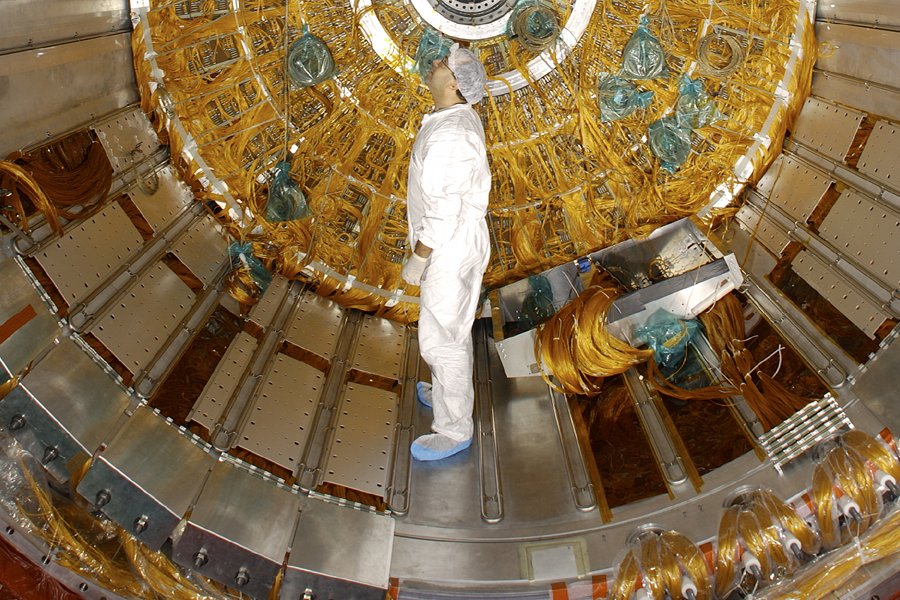
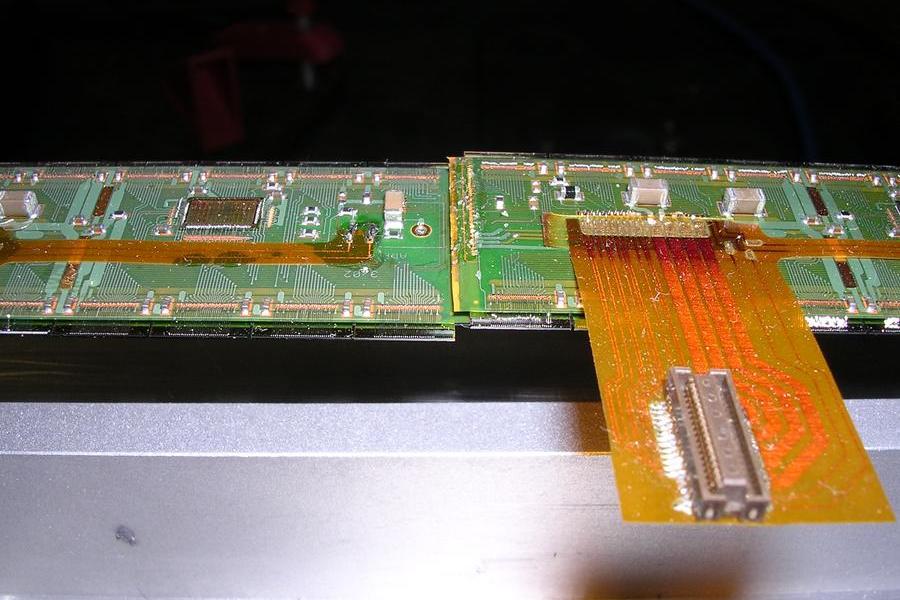
Our group contributed to the design, construction, testing, and implementation of several detector subsystems: the pixel detector (front-end electronics, mechanics, cooling), the electromagnetic calorimeter (end-cap construction leadership), and the trigger system (high-level architecture). Building on this expertise, we are actively involved in performance studies of physics objects, in particular b-quark jets, electrons, photons, and track reconstruction.
Our main scientific program for the ongoing Run 3 is the study of processes producing pairs of Higgs bosons decaying into bbyy and bbττ, both to constrain the Higgs boson self-coupling and to search for potential new particles. The team is taking advantage of Run 3 to optimize the analysis methods for these channels, while also pursuing searches for new physics beyond the Standard Model of particle physics that can benefit from the current dataset.
In preparation for the High-Luminosity LHC (HL-LHC) phase, which will start in 2030 with Run 4, our team is strongly involved in the replacement of the Inner Tracker (ITk) pixel detector and the readout of the liquid-argon calorimeter. Finally, the group contributes its expertise to R&D and physics studies for future collider projects.
Researchers and Research Professors
- Georges Aad
- Marlon Barbero
- Arnaud Duperrin (Team Leader)
- Emmanuel Monnier
- Elemer Nagy
- Elisabeth Petit
- Alexandre Rozanov
- Thomas Strebler
- Mossadek Talby
- Timothée Theveneaux-Pelzer
Engineers and Technicians
- Ahmaidi Myriam, service mécanique
- Kevin Arnaud, service électronique
- Pierre Barrillon, service détecteurs et données
- Amira Bouzourene, service détecteurs et données (Apprenti)
- Patrick Breugnon, service électronique
- Laurence Caillat, cellule qualité
- Bernard Dinkespiler, service électronique
- Farès Djama, service détecteurs et données
- Denis Fougeron, service électronique
- Fabrice Gallo, service mécanique
- Fabrice Gensolen, service électronique
- Pierre Karst, service mécanique
- Edith Knoops, service détecteurs et données
- Paul Lacroix, cellule qualité
- Danièle Laugier, service détecteurs et données
- Jean-Philippe Logier, service mécanique
- Mohsine Menouni, service électronique
- Mathieu Niclas, service mécanique
- Patrick Pangaud, service électronique
- Théo Pariset, service détecteurs et données (Apprenti)
- Françoise Riviere, service mécanique
- Franck Salomon, service électronique
- Léa Trouillet, service mécanique
- Felipe Vaccari, service électronique
- Eric Vigeolas, service mécanique
- Teo Weicherding, service électronique
PhD students
- Raphaël Bertrand
- Christian Mavungu Tsava
- Leonardo Splendori
- Grigorii Tolkachev
- Vincenzo Triglione
- Katarina Kazakova
Post-doctoral fellows
- Zhibo Wu (2025-2027)
(Bourse CIFRE)
(à Pékin - Bourse en cotutelle France-Chine)
Articles
2026: 30 articles
- Electroweak diboson production in association with a high-mass dijet system in semileptonic final states from collisions at TeV with the ATLAS detector, G. Aad et al., ATLAS Collaboration, Eur. Phys. J. C 86 (2026) 433
- Evidence for the collective nature of radial flow in Pb+Pb collisions with the ATLAS detector, G. Aad et al., ATLAS Collaboration, Phys. Rev. Lett 136 (2026) 032301
- Characterization of nuclear breakup as a function of hard-scattering kinematics using dijets measured by ATLAS in +Pb collisions, G. Aad et al., ATLAS Collaboration, Phys. Lett. B 877 (2026) 140440
- Transforming jet flavour tagging at ATLAS, G. Aad et al., ATLAS Collaboration, Nat. Commun. 17 (2026) 541
- Measurements of differential cross-sections of production in the dilepton channel in collisions at = 13 TeV using the ATLAS detector, G. Aad et al., ATLAS Collaboration, J. High Energy Phys. 02 (2026) 153
- Study of Higgs boson pair production in the final state with 308 fb of data collected at TeV and 13.6 TeV by the ATLAS experiment, G. Aad et al., ATLAS Collaboration, Phys. Lett. B 876 (2026) 140280
- Search for the Higgs boson decay to a boson and a photon in collisions at TeV and TeV with the ATLAS detector, G. Aad et al., ATLAS Collaboration, Phys. Lett. B 876 (2026) 140313
- Search for Beyond the Standard Model physics with anomaly detection in multilepton final states in collisions at TeV with the ATLAS detector, G. Aad et al., ATLAS Collaboration, Eur. Phys. J. C 86 (2026) 247
- Search for heavy neutral leptons in decays of W bosons produced in 13 TeV collisions using prompt signatures in the ATLAS detector, G. Aad et al., ATLAS Collaboration, Eur. Phys. J. C 86 (2026) 153
- Measurement of coherent exclusive $J/ψ\toμ^+μ^-$ production in ultraperipheral Pb+Pb collisions at TeV with the ATLAS detector, G. Aad et al., ATLAS Collaboration, J. High Energy Phys. 04 (2026) 020
- Measurement of the azimuthal anisotropy of charged particles in TeV OO and NeNe collisions with the ATLAS detector, G. Aad et al., ATLAS Collaboration, Phys. Rev. C 113 (2026) 045205
- Observation of structures in the mass spectrum with the ATLAS detector, G. Aad et al., ATLAS Collaboration, Phys. Rev. D 113 (2026) 112015
- Search for Higgs bosons produced in association with a high-energy photon via vector-boson fusion and decaying to a pair of -quarks in the ATLAS detector, G. Aad et al., ATLAS Collaboration, Phys. Lett. B 877 (2026) 140279
- Measurement of the -boson angular coefficients and transverse momentum in collisions at TeV with the ATLAS detector, G. Aad et al., ATLAS Collaboration, Eur. Phys. J. C 86 (2026) 483
- Observation of production in collisions at = 13 TeV with the ATLAS detector and constraints on anomalous quartic gauge-boson couplings, G. Aad et al., ATLAS Collaboration, Phys. Lett. B 873 (2026) 140050
- Precise measurement of the production cross-section and lepton differential distributions in dilepton events from TeV collisions with the ATLAS detector, G. Aad et al., ATLAS Collaboration, Eur. Phys. J. C 86 (2026) 470
- Measurement of the top-quark Yukawa coupling from production in the lepton+jets final state using collisions at TeV with the ATLAS detector, G. Aad et al., ATLAS Collaboration, J. High Energy Phys. 01 (2026) 117
- A search for electroweak production in multileptonic final states at TeV with the ATLAS detector and bounds on effective field theory operators, G. Aad et al., ATLAS Collaboration, Phys. Rev. D 114 (2026) 012001
- Search for a resonance decaying into a scalar particle and a Higgs boson in the final state with two bottom quarks and two photons with 199 fb of data collected at =13 and 13.6 TeV with the ATLAS detector, G. Aad et al., ATLAS Collaboration, Phys. Lett. B 877 (2026) 140425
- Optimised neural networks for online processing of ATLAS calorimeter data on FPGAs, G. Aad et al., indéfini, Eur. Phys. J. C 86 (2026) 111
- Search for emerging jets in collisions at TeV with the ATLAS experiment, G. Aad et al., ATLAS Collaboration, Eur. Phys. J. C 86 (2026) 808
- Measurement of the Higgs boson production in association with top quarks in multilepton final states in collisions at TeV with the ATLAS detector, G. Aad et al., ATLAS Collaboration, J. High Energy Phys. 05 (2026) 183
- Constraints on effective field theories via quadruple-differential angular decay rates from -channel single-top-quark production at TeV with the ATLAS detector, G. Aad et al., ATLAS Collaboration, J. High Energy Phys. 07 (2026) 107
- Differential cross-section measurements of coherent production of singly and doubly resonant top-quark in events with one lepton at = 13 TeV with the ATLAS detector, G. Aad et al., ATLAS Collaboration, J. High Energy Phys. 07 (2026) 028
- Search for higgsinos in compressed mass spectra using low-momentum tracks in collisions at TeV with the ATLAS detector, G. Aad et al., ATLAS Collaboration, J. High Energy Phys. 06 (2026) 094
- Search for signatures of electroweakinos with photons, jets, and large missing transverse momentum in TeV pp collisions with the ATLAS detector, G. Aad et al., ATLAS Collaboration, J. High Energy Phys. 04 (2026) 150
- Measurement of the top-quark mass using decays with a meson at $=$13 TeV with the ATLAS detector, G. Aad et al., ATLAS Collaboration, J. High Energy Phys. 04 (2026) 099
- Measurement of differential -channel single top (anti)quark production cross-sections at 13 TeV with the ATLAS detector, G. Aad et al., ATLAS Collaboration, J. High Energy Phys. 05 (2026) 174
- Search for long-lived particles using displaced vertices of oppositely charged leptons in 140 fb of pp collisions at TeV with the ATLAS detector, G. Aad et al., ATLAS Collaboration, Phys. Lett. B 878 (2026) 140497
- Ring oscillator performance of the ATLAS inner tracker pixel readout chip, Y. Khwaira et al., indéfini, J. Instrum 21 (2026) P02025
2025: 95 articles
- The performance of missing transverse momentum reconstruction and its significance with the ATLAS detector using 140 fb of TeV collisions, G. Aad et al., ATLAS Collaboration, Eur. Phys. J. C 85 (2025) 606
- The quest to discover supersymmetry at the ATLAS experiment, G. Aad et al., ATLAS Collaboration, Phys. Rep. 1116 (2025) 261-300
- Exploration at the high-energy frontier: ATLAS Run 2 searches investigating the exotic jungle beyond the Standard Model, G. Aad et al., ATLAS Collaboration, Phys. Rep. 1116 (2025) 301-385
- Software and computing for Run 3 of the ATLAS experiment at the LHC, G. Aad et al., ATLAS Collaboration, Eur. Phys. J. C 85 (2025) 234
- Electroweak, QCD and flavour physics studies with ATLAS data from Run 2 of the LHC, G. Aad et al., ATLAS Collaboration, Phys. Rep. 1116 (2025) 57-126
- Climbing to the Top of the ATLAS 13 TeV data, G. Aad et al., ATLAS Collaboration, Phys. Rep. 1116 (2025) 127-183
- ATLAS searches for additional scalars and exotic Higgs boson decays with the LHC Run 2 dataset, G. Aad et al., ATLAS Collaboration, Phys. Rep. 1116 (2025) 184-260
- Total cost of ownership and evaluation of Google cloud resources for the ATLAS experiment at the LHC, G. Aad et al., ATLAS Collaboration, Comput. Softw. Big Sci. 9 (2025) 2
- Search for diphoton resonances in the 66 to 110 GeV mass range using collisions at TeV with the ATLAS detector, G. Aad et al., ATLAS Collaboration, J. High Energy Phys. 01 (2025) 053
- Search for light neutral particles decaying promptly into collimated pairs of electrons or muons in collisions at = 13 TeV with the ATLAS detector, G. Aad et al., ATLAS Collaboration, Eur. Phys. J. C 85 (2025) 335
- Search for a light charged Higgs boson in decays, with , in collisions at TeV with the ATLAS detector, G. Aad et al., ATLAS Collaboration, Eur. Phys. J. C 85 (2025) 153
- Measurement of the Lund jet plane in hadronic decays of top quarks and W bosons with the ATLAS detector, G. Aad et al., ATLAS Collaboration, Eur. Phys. J. C 85 (2025) 416
- Combination of searches for singly and doubly charged Higgs bosons produced via vector-boson fusion in proton-proton collisions at TeV with the ATLAS detector, G. Aad et al., ATLAS Collaboration, Phys. Lett. B 860 (2025) 139137
- Constraint on the total width of the Higgs boson from Higgs boson and four-top-quark measurements in collisions at = 13 TeV with the ATLAS detector, G. Aad et al., ATLAS Collaboration, Phys. Lett. B 861 (2025) 139277
- Measurement of the associated production of a top-antitop-quark pair and a Higgs boson decaying into a pair in collisions at TeV using the ATLAS detector at the LHC, G. Aad et al., ATLAS Collaboration, Eur. Phys. J. C 85 (2025) 210
- Search for dark matter produced in association with a dark Higgs boson in the final state using collisions at TeV with the ATLAS detector, G. Aad et al., ATLAS Collaboration, Phys. Rev. Lett 134 (2025) 121801
- Measurement of production in association with additional -jets in the final state in proton-proton collisions at =13 TeV with the ATLAS detector, G. Aad et al., ATLAS Collaboration, J. High Energy Phys. 01 (2025) 068
- Search for the associated production of charm quarks and a Higgs boson decaying into a photon pair with the ATLAS detector, G. Aad et al., ATLAS Collaboration, J. High Energy Phys. 02 (2025) 045
- A precise measurement of the jet energy scale derived from single-particle measurements and in situ techniques in proton-proton collisions at 13 TeV with the ATLAS detector, G. Aad et al., ATLAS Collaboration, Eur. Phys. J. C 85 (2025) 927
- Differential cross-section measurements of Higgs boson production in the decay channel in collisions at TeV with the ATLAS detector, G. Aad et al., ATLAS Collaboration, J. High Energy Phys. 03 (2025) 010
- Search for boosted low-mass resonances decaying into hadrons produced in association with a photon in pp collisions at $=$13 TeV with the ATLAS detector, G. Aad et al., ATLAS Collaboration, J. High Energy Phys. 01 (2025) 099
- Search for the jet-induced diffusion wake in the quark-gluon plasma via measurements of jet-track correlations in photon-jet events in Pb+Pb collisions at = 5.02 TeV with the ATLAS detector, G. Aad et al., ATLAS Collaboration, Phys. Rev. C 111 (2025) 044909
- Combination of searches for singly produced vector-like top quarks in pp collisions at TeV with the ATLAS detector, G. Aad et al., ATLAS Collaboration, Phys. Rev. D 111 (2025) 012012
- Search for magnetic monopole pair production in ultraperipheral Pb+Pb collisions at TeV with the ATLAS detector at the LHC, G. Aad et al., ATLAS Collaboration, Phys. Rev. Lett 134 (2025) 061803
- Search for production in proton-proton collisions at TeV with the ATLAS detector, G. Aad et al., ATLAS Collaboration, Eur. Phys. J. C 85 (2025) 573
- Measurement of photonuclear jet production in ultra-peripheral Pb+Pb collisions at TeV with the ATLAS detector, G. Aad et al., ATLAS Collaboration, Phys. Rev. D 111 (2025) 052006
- Measurement of top-quark pair production in association with charm quarks in proton-proton collisions at TeV with the ATLAS detector, G. Aad et al., ATLAS Collaboration, Phys. Lett. B 860 (2025) 139177
- Search for same-charge top-quark pair production in collisions at 13 TeV with the ATLAS detector, G. Aad et al., ATLAS Collaboration, J. High Energy Phys. 02 (2025) 084
- Search for single-production of vector-like quarks decaying into in the fully hadronic final state in collisions at TeV with the ATLAS detector, G. Aad et al., ATLAS Collaboration, J. High Energy Phys. 02 (2025) 075
- Prospects for sub-EW ALP searches via signatures at the LHC using jet substructure techniques, A. Adhikary et al., indéfini, Phys. Rev. D 112 (2025) 5
- Type-II Seesaw Higgs triplet productions and decays at the LHC, O. A. Ducu et al., indéfini, J. High Energy Phys. 06 (2025) 020
- Search for displaced leptons in TeV and TeV collisions with the ATLAS detector, G. Aad et al., ATLAS Collaboration, Phys. Rev. D 112 (2025) 012016
- Search for a new scalar decaying into new spin-1 bosons in four-lepton final states with the ATLAS detector, G. Aad et al., ATLAS Collaboration, Phys. Lett. B 865 (2025) 139472
- Search for supersymmetry in final states with missing transverse momentum and charm-tagged jets using 139 fb of proton-proton collisions at 13 TeV with the ATLAS detector, G. Aad et al., ATLAS Collaboration, J. High Energy Phys. 02 (2025) 193
- Measurements of and production with Higgs boson decays into bottom quarks and direct constraints on the charm Yukawa coupling in collisions with the ATLAS detector, G. Aad et al., ATLAS Collaboration, J. High Energy Phys. 04 (2025) 075
- A search for triple Higgs boson production in the final state using collisions at TeV with the ATLAS detector, G. Aad et al., ATLAS Collaboration, Phys. Rev. D 111 (2025) 032006
- Search for a heavy charged Higgs boson decaying into a boson and a Higgs boson in final states with leptons and -jets in TeV collisions with the ATLAS detector, G. Aad et al., ATLAS Collaboration, J. High Energy Phys. 02 (2025) 143
- Search for vector-like leptons coupling to first- and second-generation Standard Model leptons in collisions at TeV with the ATLAS detector, G. Aad et al., ATLAS Collaboration, J. High Energy Phys. 05 (2025) 075
- Reconstruction and identification of pairs of collimated -leptons decaying hadronically using TeV collision data with the ATLAS detector, G. Aad et al., ATLAS Collaboration, Eur. Phys. J. C 85 (2025) 561
- Precision measurement of the meson lifetime using decays with the ATLAS detector, G. Aad et al., ATLAS Collaboration, Eur. Phys. J. C 85 (2025) 736
- Observation of top-quark pair production in lead-lead collisions at TeV with the ATLAS detector, G. Aad et al., ATLAS Collaboration, Phys. Rev. Lett 134 (2025) 142301
- Search for Higgs boson decays into a boson and a light hadronically decaying resonance in 140 fb of 13 TeV collisions with the ATLAS detector, G. Aad et al., ATLAS Collaboration, Phys. Lett. B 868 (2025) 139671
- Measurement of off-shell Higgs boson production in the decay channel using a neural simulation-based inference technique in 13 TeV collisions with the ATLAS detector, G. Aad et al., ATLAS Collaboration, Rep. Prog. Phys. 88 (2025) 057803
- Precision calibration of calorimeter signals in the ATLAS experiment using an uncertainty-aware neural network, G. Aad et al., ATLAS Collaboration, SciPost Phys. 19 (2025) 155
- Test of lepton flavour universality in -boson decays into electrons and -leptons using collisions at TeV with the ATLAS detector, G. Aad et al., ATLAS Collaboration, J. High Energy Phys. 05 (2025) 038
- Cross-section measurements for the production of a -boson in association with high-transverse-momentum jets in collisions at = 13 TeV with the ATLAS detector, G. Aad et al., ATLAS Collaboration, Eur. Phys. J. C 85 (2025) 738
- Search for Higgs boson decays into a pair of pseudoscalar particles in the final state using collisions at TeV with the ATLAS detector, G. Aad et al., ATLAS Collaboration, J. High Energy Phys. 03 (2025) 190
- Observation of production at TeV with the ATLAS detector, G. Aad et al., ATLAS Collaboration, Phys. Lett. B 866 (2025) 139527
- Expected Tracking Performance of the ATLAS Inner Tracker at the High-Luminosity LHC, G. Aad et al., ATLAS Collaboration, J. Instrum 20 (2025) P02018
- Improved reconstruction of highly boosted -lepton pairs in the decay channels with the ATLAS detector, G. Aad et al., ATLAS Collaboration, Eur. Phys. J. C 85 (2025) 706
- Azimuthal anisotropies of charged particles with high transverse momentum in Pb+Pb collisions at TeV with the ATLAS detector, G. Aad et al., ATLAS Collaboration, Phys. Rev. C 112 (2025) 024910
- Energy scale and resolution for anti- jets with radius parameters and 0.6 measured in proton-proton collisions at TeV with the ATLAS detector, G. Aad et al., ATLAS Collaboration, Eur. Phys. J. C 85 (2025) 791
- Differential cross-section measurements of and meson production in proton-proton collisions at TeV with the ATLAS detector, G. Aad et al., ATLAS Collaboration, J. High Energy Phys. 07 (2025) 086
- Search for charged Higgs bosons produced in top-quark decays or in association with top quarks and decaying via in 13 TeV collisions with the ATLAS detector, G. Aad et al., ATLAS Collaboration, Phys. Rev. D 111 (2025) 072006
- Configuration, Performance, and Commissioning of the ATLAS -jet Triggers for the 2022 and 2023 LHC data-taking periods, G. Aad et al., ATLAS Collaboration, J. Instrum 20 (2025) P03002
- Measurement of jet track functions in collisions at TeV with the ATLAS detector, G. Aad et al., ATLAS Collaboration, Phys. Lett. B 868 (2025) 139680
- Estimation of backgrounds from jets misidentified as -leptons using the Universal Fake Factor method with the ATLAS detector, G. Aad et al., ATLAS Collaboration, Eur. Phys. J. C 85 (2025) 1441
- Search for long-lived charged particles using large specific ionisation loss and time of flight in 140 of collisions at TeV with the ATLAS detector, G. Aad et al., ATLAS Collaboration, J. High Energy Phys. 07 (2025) 140
- Weakly supervised anomaly detection for resonant new physics in the dijet final state using proton-proton collisions at TeV with the ATLAS detector, G. Aad et al., ATLAS Collaboration, Phys. Rev. D 112 (2025) 072009
- Measurement of -boson differential cross-sections in proton-proton collisions with low pile-up data at TeV and TeV with the ATLAS detector, G. Aad et al., ATLAS Collaboration, Eur. Phys. J. C 85 (2025) 729
- Measurement of the top quark mass with the ATLAS detector using events with a high transverse momentum top quark, G. Aad et al., ATLAS Collaboration, Phys. Lett. B 867 (2025) 139608
- Measurement of double-differential charged-current Drell-Yan cross-sections at high transverse masses in collisions at 13 TeV with the ATLAS detector, G. Aad et al., ATLAS Collaboration, J. High Energy Phys. 07 (2025) 026
- Search for Higgs boson exotic decays into Lorentz-boosted light bosons in the four- final state at TeV with the ATLAS detector, G. Aad et al., ATLAS Collaboration, Phys. Lett. B 870 (2025) 139843
- Charged-hadron and identified-hadron (, , ) yield measurements in photo-nuclear Pb+Pb and +Pb collisions at TeV with ATLAS, G. Aad et al., ATLAS Collaboration, Phys. Rev. C 111 (2025) 064908
- Evidence for longitudinally polarized bosons in the electroweak production of same-sign boson pairs in association with two jets in pp collisions at TeV with the ATLAS detector, G. Aad et al., ATLAS Collaboration, Phys. Rev. Lett 135 (2025) 111802
- Search for cascade decays of charged sleptons and sneutrinos in final states with three leptons and missing transverse momentum in collisions at TeV with the ATLAS detector, G. Aad et al., ATLAS Collaboration, Phys. Rev. D 112 (2025) 012005
- Search for heavy neutral leptons in decays of W bosons using leptonic and semi-leptonic displaced vertices in TeV collisions with the ATLAS detector, G. Aad et al., ATLAS Collaboration, J. High Energy Phys. 07 (2025) 196
- Search for a new pseudoscalar decaying into a pair of bottom and antibottom quarks in top-associated production in =13 TeV proton-proton collisions with the ATLAS detector, G. Aad et al., ATLAS Collaboration, Eur. Phys. J. C 85 (2025) 886
- Searches for direct slepton production in the compressed-mass corridor in TeV collisions with the ATLAS detector, G. Aad et al., ATLAS Collaboration, J. High Energy Phys. 08 (2025) 053
- A measurement of the high-mass $τ\barτ$ production cross-section at TeV with the ATLAS detector and constraints on new particles and couplings, G. Aad et al., ATLAS Collaboration, J. High Energy Phys. 10 (2025) 054
- Measurements of the production cross-sections of a Higgs boson in association with a vector boson and decaying into with the ATLAS detector at TeV, G. Aad et al., ATLAS Collaboration, J. High Energy Phys. 08 (2025) 034
- Search for events with one displaced vertex from long-lived neutral particles decaying into hadronic jets in the ATLAS muon spectrometer in collisions at TeV, G. Aad et al., ATLAS Collaboration, Phys. Rev. D 112 (2025) 092001
- Search for electroweak production of vector-like leptons in -lepton and -jet final states in collisions at = 13 TeV with the ATLAS detector, G. Aad et al., ATLAS Collaboration, Eur. Phys. J. C 85 (2025) 1335
- Measurement of substructure-dependent suppression of large-radius jets with charged particles in Pb+Pb collisions with ATLAS, G. Aad et al., ATLAS Collaboration, Phys. Lett. B 871 (2025) 139929
- Measurement of high-mass production and lepton flavour universality-inspired effective field theory interpretations at TeV with the ATLAS detector, G. Aad et al., ATLAS Collaboration, Eur. Phys. J. C 85 (2025) 1434
- Measurements of Higgs boson production via gluon-gluon fusion and vector-boson fusion using decays in collisions with the ATLAS detector and their effective field theory interpretations, G. Aad et al., ATLAS Collaboration, Eur. Phys. J. C 85 (2025) 1403
- Constraining off-shell Higgs boson production and the Higgs boson total width using $WW\to \ellν\ellν$ final states with the ATLAS detector, G. Aad et al., ATLAS Collaboration, Phys. Lett. B 870 (2025) 139898
- Search for new physics in final states with semi-visible jets or anomalous signatures using the ATLAS detector, G. Aad et al., ATLAS Collaboration, Phys. Rev. D 112 (2025) 012021
- Search for emerging jets in collisions at TeV with the ATLAS experiment, G. Aad et al., ATLAS Collaboration, Rep. Prog. Phys. 88 (2025) 097801
- The environmental impact, carbon emissions and sustainability of computing in the ATLAS experiment, G. Aad et al., ATLAS Collaboration, Eur. Phys. J. C 85 (2025) 1397
- Observation of double parton scattering in same-sign W boson pair production in pp collisions at TeV with the ATLAS detector, G. Aad et al., ATLAS Collaboration, Phys. Lett. B 870 (2025) 139892
- Measurements of production cross-sections in collisions at TeV with the ATLAS detector, G. Aad et al., ATLAS Collaboration, J. High Energy Phys. 08 (2025) 142
- A continuous calibration of the ATLAS flavour-tagging classifiers via optimal transportation maps, G. Aad et al., ATLAS Collaboration, Eur. Phys. J. C 85 (2025) 1272
- An implementation of neural simulation-based inference for parameter estimation in ATLAS, G. Aad et al., ATLAS Collaboration, Rep. Prog. Phys. 88 (2025) 067801
- Search for single production of vector-like quarks decaying into in collisions at TeV with the ATLAS detector, G. Aad et al., ATLAS Collaboration, J. High Energy Phys. 12 (2025) 012
- Probing the Higgs boson CP properties in vector-boson fusion production in the $H\rightarrowτ^+τ^-$ channel with the ATLAS detector, G. Aad et al., ATLAS Collaboration, J. High Energy Phys. 10 (2025) 092
- Search for squarks and gluinos in collisions at TeV and TeV in events with -leptons, jets and missing transverse momentum using the ATLAS detector, G. Aad et al., ATLAS Collaboration, Eur. Phys. J. C 85 (2025) 1437
- Search for decays of the Higgs boson into scalar particles decaying into four or six -quarks using collisions at with the ATLAS detector, G. Aad et al., ATLAS Collaboration, Phys. Rev. D 112 (2025) 072005
- A search for dark matter produced in association with a dark Higgs boson decaying into a Higgs boson pair in 3 or 4 final states using collisions at TeV with the ATLAS detector, G. Aad et al., ATLAS Collaboration, J. High Energy Phys. 09 (2025) 067
- Measurement of the top-quark pole mass in dileptonic events at TeV with the ATLAS experiment, G. Aad et al., ATLAS Collaboration, J. High Energy Phys. 12 (2025) 023
- Measurements and interpretations of production cross-sections in collisions at 13 TeV with the ATLAS detector, G. Aad et al., ATLAS Collaboration, J. High Energy Phys. 11 (2025) 006
- Search for resonant leptoquark production via lepton-jet signatures in collisions at TeV and TeV with the ATLAS detector, G. Aad et al., ATLAS Collaboration, J. High Energy Phys. 12 (2025) 180
- Evidence for the dimuon decay of the Higgs boson in pp collisions with the ATLAS detector, G. Aad et al., ATLAS Collaboration, Phys. Rev. Lett 135 (2025) 231802
- Search for the production of a Higgs boson in association with a single top quark in collisions at TeV with the ATLAS detector, G. Aad et al., ATLAS Collaboration, J. High Energy Phys. 10 (2025) 093
- Search for electroweak-scale dijet resonances using trigger-level analysis with the ATLAS detector in fb of collisions at TeV, G. Aad et al., ATLAS Collaboration, Phys. Rev. D 112 (2025) 092015
2024: 123 articles
- Deep generative models for fast photon shower simulation in ATLAS, G. Aad et al., ATLAS Collaboration, Comput. Softw. Big Sci. 8 (2024) 7
- Probing the nature of the top-Higgs Yukawa coupling in and events with decays using the ATLAS detector at the LHC, G. Aad et al., ATLAS Collaboration, Phys. Lett. B 849 (2024) 138469
- Search for top-philic heavy resonances in collisions at TeV with the ATLAS detector, G. Aad et al., ATLAS Collaboration, Eur. Phys. J. C 84 (2024) 157
- Test of CP-invariance of the Higgs boson in vector-boson fusion production and in its decay into four leptons, G. Aad et al., ATLAS Collaboration, J. High Energy Phys. 2405 (2024) 105
- Observation of production in collisions at TeV with the ATLAS detector, G. Aad et al., ATLAS Collaboration, Phys. Rev. Lett 132 (2024) 021802
- The ATLAS Experiment at the CERN Large Hadron Collider: A Description of the Detector Configuration for Run 3, G. Aad et al., ATLAS Collaboration, J. Instrum 19 (2024) P05063
- Search for non-resonant production of semi-visible jets using Run 2 data in ATLAS, G. Aad et al., ATLAS Collaboration, Phys. Lett. B 848 (2024) 138324
- Combination and summary of ATLAS dark matter searches interpreted in a 2HDM with a pseudo-scalar mediator using 139 fb of TeV collision data, G. Aad et al., ATLAS Collaboration, Sci. Bull. 69 (2024) 3005-3035
- Measurement of the and cross-sections in collisions at TeV with the ATLAS detector, G. Aad et al., ATLAS Collaboration, Eur. Phys. J. C 84 (2024) 78
- Search for leptoquark pair production decaying into or in multi-lepton final states in pp collisions at with the ATLAS detector, G. Aad et al., ATLAS Collaboration, Eur. Phys. J. C 84 (2024) 818
- Search for leptoquark pair production decaying into or in multi-lepton final states in collisions at 13 TeV with the ATLAS detector, G. Aad et al., ATLAS Collaboration, Eur. Phys. J. C 84 (2024) 818
- Search for pair production of squarks or gluinos decaying via sleptons or weak bosons in final states with two same-sign or three leptons with the ATLAS detector, G. Aad et al., ATLAS Collaboration, J. High Energy Phys. 02 (2024) 107
- Search for new phenomena in two-body invariant mass distributions using unsupervised machine learning for anomaly detection at TeV with the ATLAS detector, G. Aad et al., ATLAS Collaboration, Phys. Rev. Lett 132 (2024) 081801
- Search for singly produced vector-like top partners in multilepton final states with 139 of collision data at TeV with the ATLAS detector, G. Aad et al., ATLAS Collaboration, Phys. Rev. D 109 (2024) 112012
- Search for quantum black hole production in lepton+jet final states using proton-proton collisions at = 13 TeV with the ATLAS detector, G. Aad et al., ATLAS Collaboration, Phys. Rev. D 109 (2024) 032010
- Performance and calibration of quark/gluon-jet taggers using 140 fb of collisions at TeV with the ATLAS detector, G. Aad et al., ATLAS Collaboration, Chin. Phys. C 48 (2024) 023001
- Observation of triboson production in proton-proton collisions at TeV with the ATLAS detector, G. Aad et al., ATLAS Collaboration, Phys. Lett. B 848 (2024) 138400
- Measurement of the cross section and its ratio to the production cross section using collisions at TeV with the ATLAS detector, G. Aad et al., ATLAS Collaboration, Phys. Lett. B 848 (2024) 138376
- Software Performance of the ATLAS Track Reconstruction for LHC Run 3, G. Aad et al., ATLAS Collaboration, Comput. Softw. Big Sci. 8 (2024) 9
- Differential cross-section measurements of the production of four charged leptons in association with two jets using the ATLAS detector, G. Aad et al., ATLAS Collaboration, J. High Energy Phys. 01 (2024) 004
- Electron and photon efficiencies in LHC Run 2 with the ATLAS experiment, G. Aad et al., ATLAS Collaboration, J. High Energy Phys. 2405 (2024) 162
- Measurement of the centrality dependence of the dijet yield in +Pb collisions at = 8.16 TeV with the ATLAS detector, G. Aad et al., ATLAS Collaboration, Phys. Rev. Lett 132 (2024) 102301
- Azimuthal angle correlations of muons produced via heavy-flavor decays in 5.02 TeV Pb+Pb and collisions with the ATLAS detector, G. Aad et al., ATLAS Collaboration, Phys. Rev. Lett 132 (2024) 202301
- Evidence for the Higgs boson decay to a boson and a photon at the LHC, G. Aad et al., ATLAS Collaboration, CMS Collaboration, Phys. Rev. Lett 132 (2024) 021803
- Search for the decay mode of new high-mass resonances in collisions at TeV with the ATLAS detector, G. Aad et al., ATLAS Collaboration, Phys. Lett. B 848 (2024) 138394
- Electron and photon energy calibration with the ATLAS detector using LHC Run 2 data, G. Aad et al., ATLAS Collaboration, J. Instrum 19 (2024) P02009
- A precise measurement of the Z-boson double-differential transverse momentum and rapidity distributions in the full phase space of the decay leptons with the ATLAS experiment at = 8 TeV, G. Aad et al., ATLAS Collaboration, Eur. Phys. J. C 84 (2024) 315
- Search for the exclusive boson hadronic decays , and with the ATLAS detector, G. Aad et al., ATLAS Collaboration, Phys. Rev. Lett 133 (2024) 161804
- Measurement of the production cross-section of and S mesons in collisions at TeV with the ATLAS detector, G. Aad et al., ATLAS Collaboration, Eur. Phys. J. C 84 (2024) 169
- Measurement of -channel single-top-quark production in collisions at TeV with the ATLAS detector, G. Aad et al., ATLAS Collaboration, Phys. Lett. B 854 (2024) 138726
- Search for non-resonant Higgs boson pair production in the final state in collisions at with the ATLAS detector, G. Aad et al., ATLAS Collaboration, J. High Energy Phys. 02 (2024) 037
- Study of decays at = 8 TeV with the ATLAS detector, G. Aad et al., ATLAS Collaboration, Eur. Phys. J. C 84 (2024) 195
- Studies of new Higgs boson interactions through nonresonant production in the final state in collisions at TeV with the ATLAS detector, G. Aad et al., ATLAS Collaboration, J. High Energy Phys. 01 (2024) 066
- Improving topological cluster reconstruction using calorimeter cell timing in ATLAS, G. Aad et al., ATLAS Collaboration, Eur. Phys. J. C 84 (2024) 455
- Search for Resonant Production of Dark Quarks in the Dijet Final State with the ATLAS Detector, G. Aad et al., ATLAS Collaboration, J. High Energy Phys. 02 (2024) 128
- Search for a CP-odd Higgs boson decaying into a heavy CP-even Higgs boson and a boson in the and final states using 140 fb of data collected with the ATLAS detector, G. Aad et al., ATLAS Collaboration, J. High Energy Phys. 02 (2024) 197
- Observation of quantum entanglement in top-quark pairs using the ATLAS detector, G. Aad et al., ATLAS Collaboration, Nature 633 (2024) 542
- Measurement of production cross-sections in the four-lepton final state in collisions at TeV with the ATLAS experiment, G. Aad et al., ATLAS Collaboration, Phys. Lett. B 855 (2024) 138764
- Simultaneous energy and mass calibration of large-radius jets with the ATLAS detector using a deep neural network, G. Aad et al., ATLAS Collaboration, Mach. Learn. Sci. Technol. 5 (2024) 035051
- Combination of searches for resonant Higgs boson pair production using collisions at TeV with the ATLAS detector, G. Aad et al., ATLAS Collaboration, Phys. Rev. Lett 132 (2024) 231801
- Search for light long-lived neutral particles from Higgs boson decays via vector-boson-fusion production from collisions at TeV with the ATLAS detector, G. Aad et al., ATLAS Collaboration, Eur. Phys. J. C 84 (2024) 719
- Measurement and interpretation of same-sign boson pair production in association with two jets in collisions at TeV with the ATLAS detector, G. Aad et al., ATLAS Collaboration, J. High Energy Phys. 04 (2024) 026
- Search for the decay of the Higgs boson to a boson and a light pseudoscalar particle decaying to two photons, G. Aad et al., ATLAS Collaboration, Phys. Lett. B 850 (2024) 138536
- Evidence for the process with the ATLAS detector in Run 2, G. Aad et al., ATLAS Collaboration, Phys. Lett. B 855 (2024) 138817
- Search for short- and long-lived axion-like particles in decays with the ATLAS experiment at the LHC, G. Aad et al., ATLAS Collaboration, Eur. Phys. J. C 84 (2024) 742
- Measurement of jet substructure in boosted events with the ATLAS detector using 140 fb of 13 TeV collisions, G. Aad et al., ATLAS Collaboration, Phys. Rev. D 109 (2024) 112016
- Measurement of the Z boson invisible width at TeV with the ATLAS detector, G. Aad et al., ATLAS Collaboration, Phys. Lett. B 854 (2024) 138705
- Inclusive and differential cross-section measurements of production in collisions at TeV with the ATLAS detector, including EFT and spin-correlation interpretations, G. Aad et al., ATLAS Collaboration, J. High Energy Phys. 2407 (2024) 163
- Study of high-momentum Higgs boson production in association with a vector boson in the final state with the ATLAS detector, G. Aad et al., ATLAS Collaboration, Phys. Rev. Lett 132 (2024) 131802
- Search for heavy resonances in final states with four leptons and missing transverse momentum or jets in collisions at TeV with the ATLAS detector, G. Aad et al., ATLAS Collaboration, J. High Energy Phys. 10 (2024) 130
- Measurement of the total and differential cross-sections of production in collisions at TeV with the ATLAS detector, G. Aad et al., ATLAS Collaboration, J. High Energy Phys. 2405 (2024) 131
- The ATLAS Trigger System for LHC Run 3 and Trigger performance in 2022, G. Aad et al., ATLAS Collaboration, J. Instrum 19 (2024) P06029
- Combination of searches for pair-produced leptoquarks at TeV with the ATLAS detector, G. Aad et al., ATLAS Collaboration, Phys. Lett. B 854 (2024) 138736
- Search for new phenomena with top-quark pairs and large missing transverse momentum using 140 of collision data at TeV with the ATLAS detector, G. Aad et al., ATLAS Collaboration, J. High Energy Phys. 03 (2024) 139
- Search for pair production of higgsinos in events with two Higgs bosons and missing transverse momentum in TeV collisions at the ATLAS experiment, G. Aad et al., ATLAS Collaboration, Phys. Rev. D 109 (2024) 112011
- Search for nearly mass-degenerate higgsinos using low-momentum mildly-displaced tracks in collisions at = 13 TeV with the ATLAS detector, G. Aad et al., ATLAS Collaboration, Phys. Rev. Lett 132 (2024) 221801
- Operation and performance of the ATLAS tile calorimeter in LHC Run 2, G. Aad et al., ATLAS Collaboration, Eur. Phys. J. C 84 (2024) 1313
- A search for R-parity-violating supersymmetry in final states containing many jets in pp collisions at $ $ = 13 TeV with the ATLAS detector, G. Aad et al., ATLAS Collaboration, J. High Energy Phys. 2405 (2024) 003
- Search for pair-production of vector-like quarks in lepton+jets final states containing at least one b-tagged jet using the Run 2 data from the ATLAS experiment, G. Aad et al., ATLAS Collaboration, Phys. Lett. B 854 (2024) 138743
- Search for electroweak production of supersymmetric particles in final states with two -leptons in = 13 TeV collisions with the ATLAS detector, G. Aad et al., ATLAS Collaboration, J. High Energy Phys. 2405 (2024) 150
- Determination of the relative sign of the Higgs boson couplings to and bosons using production via vector-boson fusion with the ATLAS detector, G. Aad et al., ATLAS Collaboration, Phys. Rev. Lett 133 (2024) 141801
- ATLAS Run 2 searches for electroweak production of supersymmetric particles interpreted within the pMSSM, G. Aad et al., ATLAS Collaboration, J. High Energy Phys. 2405 (2024) 106
- Interpretations of the ATLAS measurements of Higgs boson production and decay rates and differential cross-sections in collisions at TeV, G. Aad et al., ATLAS Collaboration, J. High Energy Phys. 11 (2024) 097
- Performance of the ATLAS forward proton Time-of-Flight detector in Run 2, G. Aad et al., ATLAS Collaboration, J. Instrum 19 (2024) P05054
- A statistical combination of ATLAS Run 2 searches for charginos and neutralinos at the LHC, G. Aad et al., ATLAS Collaboration, Phys. Rev. Lett 133 (2024) 031802
- Combination of searches for heavy spin-1 resonances using 139 fb of proton-proton collision data at $ $ = 13 TeV with the ATLAS detector, G. Aad et al., ATLAS Collaboration, J. High Energy Phys. 2404 (2024) 118
- A search for top-squark pair production, in final states containing a top quark, a charm quark and missing transverse momentum, using the 139 fb of collision data collected by the ATLAS detector, G. Aad et al., ATLAS Collaboration, J. High Energy Phys. 07 (2024) 250
- Measurements of Lund subjet multiplicities in 13 TeV proton-proton collisions with the ATLAS detector, G. Aad et al., ATLAS Collaboration, Phys. Lett. B 859 (2024) 139090
- A search for top-squark pair production, in final states containing a top quark, a charm quark and missing transverse momentum, using the 139 fb of pp collision data collected by the ATLAS detector, G. Aad et al., ATLAS Collaboration, J. High Energy Phys. 2407 (2024) 250
- Search for a new gauge boson via the process in collisions at TeV with the ATLAS detector, G. Aad et al., ATLAS Collaboration, Phys. Rev. D 110 (2024) 072008
- Search for high-mass resonances in final states with a -lepton and missing transverse momentum with the ATLAS detector, G. Aad et al., ATLAS Collaboration, Phys. Rev. D 109 (2024) 112008
- Studies of the energy dependence of diboson polarization fractions and the Radiation Amplitude Zero effect in WZ production with the ATLAS detector, G. Aad et al., ATLAS Collaboration, Phys. Rev. Lett 133 (2024) 101802
- Search for new particles in final states with a boosted top quark and missing transverse momentum in proton-proton collisions at $ $ = 13 TeV with the ATLAS detector, G. Aad et al., ATLAS Collaboration, J. High Energy Phys. 2405 (2024) 263
- Searches for exclusive Higgs boson decays into and boson decays into and in collisions at TeV with the ATLAS detector, G. Aad et al., ATLAS Collaboration, Phys. Lett. B 855 (2024) 138762
- Precise test of lepton flavour universality in -boson decays into muons and electrons in collisions at TeV with the ATLAS detector, G. Aad et al., ATLAS Collaboration, Eur. Phys. J. C 84 (2024) 993
- Measurement of t-channel production of single top quarks and antiquarks in pp collisions at 13 TeV using the full ATLAS Run 2 data sample, G. Aad et al., ATLAS Collaboration, J. High Energy Phys. 2405 (2024) 305
- Fiducial and differential cross-section measurements of electroweak production in collisions at TeV with the ATLAS detector, G. Aad et al., ATLAS Collaboration, Eur. Phys. J. C 84 (2024) 1064
- Differential cross-sections for events with missing transverse momentum and jets measured with the ATLAS detector in 13 TeV proton-proton collisions, G. Aad et al., ATLAS Collaboration, J. High Energy Phys. 2408 (2024) 223
- Observation of electroweak production of WW in association with jets in proton-proton collisions at $ $ = 13 TeV with the ATLAS detector, G. Aad et al., ATLAS Collaboration, J. High Energy Phys. 2407 (2024) 254
- Search for charged-lepton-flavour violating interactions in top-quark production and decay in collisions at TeV with the ATLAS detector at the LHC, G. Aad et al., ATLAS Collaboration, Phys. Rev. D 110 (2024) 012014
- Search for low-mass resonances decaying into two jets and produced in association with a photon or a jet at TeV with the ATLAS detector, G. Aad et al., ATLAS Collaboration, Phys. Rev. D 110 (2024) 032002
- Measurements of inclusive and differential cross-sections of production in collisions at TeV with the ATLAS detector, G. Aad et al., ATLAS Collaboration, J. High Energy Phys. 10 (2024) 191
- Measurement of vector boson production cross sections and their ratios using pp collisions at TeV with the ATLAS detector, G. Aad et al., ATLAS Collaboration, Phys. Lett. B 854 (2024) 138725
- Search for heavy Majorana neutrinos in and final states via WW scattering in collisions at TeV with the ATLAS detector, G. Aad et al., ATLAS Collaboration, Phys. Lett. B 856 (2024) 138865
- Measurements of the production cross-section for a boson in association with - or -jets in proton-proton collisions at TeV with the ATLAS detector, G. Aad et al., ATLAS Collaboration, Eur. Phys. J. C 84 (2024) 984
- Search for light long-lived particles in collisions at TeV using displaced vertices in the ATLAS inner detector, G. Aad et al., ATLAS Collaboration, Phys. Rev. Lett 133 (2024) 161803
- Measurement of the W-boson mass and width with the ATLAS detector using proton-proton collisions at = 7 TeV, G. Aad et al., ATLAS Collaboration, Eur. Phys. J. C 84 (2024) 1309
- Measurements of electroweak boson pair production in association with two jets in collisions at TeV with the ATLAS detector, G. Aad et al., ATLAS Collaboration, J. High Energy Phys. 2406 (2024) 192
- Search for pair-produced higgsinos decaying via Higgs or bosons to final states containing a pair of photons and a pair of -jets with the ATLAS detector, G. Aad et al., ATLAS Collaboration, Phys. Lett. B 856 (2024) 138938
- Search for flavour-changing neutral-current couplings between the top quark and the Higgs boson in multi-lepton final states in 13 TeV collisions with the ATLAS detector, G. Aad et al., ATLAS Collaboration, Eur. Phys. J. C 84 (2024) 757
- Precise measurements of - and -boson transverse momentum spectra with the ATLAS detector using collisions at TeV and TeV, G. Aad et al., ATLAS Collaboration, Eur. Phys. J. C 84 (2024) 1126
- Characterising the Higgs boson with ATLAS data from Run 2 of the LHC, G. Aad et al., ATLAS Collaboration, Phys. Rep. 11 (2024) 001
- Search for a resonance decaying into a scalar particle and a Higgs boson in the final state with two bottom quarks and two photons in proton-proton collisions at a center of mass energy of 13 TeV with the ATLAS detector, G. Aad et al., ATLAS Collaboration, J. High Energy Phys. 11 (2024) 047
- Search for the non-resonant production of Higgs boson pairs via gluon fusion and vector-boson fusion in the final state in proton-proton collisions at TeV with the ATLAS detector, G. Aad et al., ATLAS Collaboration, Phys. Rev. D 110 (2024) 032012
- Constraints on dark matter models involving an -channel mediator with the ATLAS detector in collisions at TeV, G. Aad et al., ATLAS Collaboration, Eur. Phys. J. C 84 (2024) 1102
- Search for pair production of boosted Higgs bosons via vector-boson fusion in the final state using collisions at TeV with the ATLAS detector, G. Aad et al., ATLAS Collaboration, Phys. Lett. B 858 (2024) 139007
- Search for heavy neutral Higgs bosons decaying into a top quark pair in 140 fb of proton-proton collision data at $ $ = 13 TeV with the ATLAS detector, G. Aad et al., ATLAS Collaboration, J. High Energy Phys. 2408 (2024) 013
- Beam-induced backgrounds measured in the ATLAS detector during local gas injection into the LHC beam vacuum, G. Aad et al., ATLAS Collaboration, J. Instrum 19 (2024) 0614
- Calibration of a soft secondary vertex tagger using proton-proton collisions at $=$13 TeV with the ATLAS detector, G. Aad et al., ATLAS Collaboration, Phys. Rev. D 110 (2024) 032015
- Observation of production in the lepton+jets and dilepton channels in +Pb collisions at TeV with the ATLAS detector, G. Aad et al., ATLAS Collaboration, J. High Energy Phys. 11 (2024) 101
- Underlying-event studies with strange hadrons in collisions at TeV with the ATLAS detector, G. Aad et al., ATLAS Collaboration, Eur. Phys. J. C 84 (2024) 1335
- Search for dark mesons decaying to top and bottom quarks in proton-proton collisions at TeV with the ATLAS detector, G. Aad et al., ATLAS Collaboration, J. High Energy Phys. 2409 (2024) 005
- Search for non-resonant Higgs boson pair production in final states with leptons, taus, and photons in collisions at = 13 TeV with the ATLAS detector, G. Aad et al., ATLAS Collaboration, J. High Energy Phys. 2408 (2024) 164
- Search for pair-produced vector-like quarks coupling to light quarks in the lepton plus jets final state using 13 TeV collisions with the ATLAS detector, G. Aad et al., ATLAS Collaboration, Phys. Rev. D 110 (2024) 052009
- Measurements of jet cross-section ratios in 13 TeV proton–proton collisions with ATLAS, G. Aad et al., ATLAS Collaboration, Phys. Rev. D 110 (2024) 072019
- A simultaneous unbinned differential cross section measurement of twenty-four +jets kinematic observables with the ATLAS detector, G. Aad et al., ATLAS Collaboration, Phys. Rev. Lett 133 (2024) 261803
- Search for a resonance decaying into a scalar particle and a Higgs boson in final states with leptons and two photons in proton-proton collisions at TeV with the ATLAS detector, G. Aad et al., ATLAS Collaboration, J. High Energy Phys. 10 (2024) 104
- Combination of searches for Higgs boson decays into a photon and a massless dark photon using collisions at TeV with the ATLAS detector, G. Aad et al., ATLAS Collaboration, J. High Energy Phys. 2408 (2024) 153
- Search for new particles in events with a hadronically decaying W or Z boson and large missing transverse momentum at = 13 TeV using the ATLAS detector, G. Aad et al., ATLAS Collaboration, J. High Energy Phys. 11 (2024) 126
- Combination of searches for Higgs boson pair production in collisions at TeV with the ATLAS detector, G. Aad et al., ATLAS Collaboration, Phys. Rev. Lett 133 (2024) 101801
- A search for -parity violating supersymmetric decays of the top squark to a -jet and a lepton in = 13 TeV collisions with the ATLAS detector, G. Aad et al., ATLAS Collaboration, Phys. Rev. D 110 (2024) 092004
- Measurement of differential cross-sections in and jets production in the lepton+jets final state in collisions at TeV using 140 fb of ATLAS data, G. Aad et al., ATLAS Collaboration, J. High Energy Phys. 2408 (2024) 182
- Search for decays of the Higgs boson into a pair of pseudoscalar particles decaying into using collisions at TeV with the ATLAS detector, G. Aad et al., ATLAS Collaboration, Phys. Rev. D 110 (2024) 052013
- Sensor response and radiation damage effects for 3D pixels in the ATLAS IBL Detector, G. Aad et al., ATLAS Collaboration, J. Instrum 19 (2024) P10008
- Disentangling sources of momentum fluctuations in Xe+Xe and Pb+Pb collisions with the ATLAS detector, G. Aad et al., ATLAS Collaboration, Phys. Rev. Lett 133 (2024) 252301
- Search for neutral long-lived particles that decay into displaced jets in the ATLAS calorimeter in association with leptons or jets using collisions at TeV, G. Aad et al., ATLAS Collaboration, J. High Energy Phys. 11 (2024) 036
- Using pile-up collisions as an abundant source of low-energy hadronic physics processes in ATLAS and an extraction of the jet energy resolution, G. Aad et al., ATLAS Collaboration, J. High Energy Phys. 12 (2024) 032
- Measurement of single top-quark production in association with a boson in collisions at TeV with the ATLAS detector, G. Aad et al., ATLAS Collaboration, Phys. Rev. D 110 (2024) 072010
- Jet radius dependence of dijet momentum balance and suppression in Pb+Pb collisions at 5.02 TeV with the ATLAS detector, G. Aad et al., ATLAS Collaboration, Phys. Rev. C 110 (2024) 054912
- Accuracy versus precision in boosted top tagging with the ATLAS detector, G. Aad et al., ATLAS Collaboration, J. Instrum 19 (2024) P08018
- Search for heavy right-handed Majorana neutrinos in the decay of top quarks produced in protonproton collisions at = 13 TeV with the ATLAS detector, G. Aad et al., ATLAS Collaboration, Phys. Rev. D 110 (2024) 112004
- Search for supersymmetry using vector boson fusion signatures and missing transverse momentum in collisions at TeV with the ATLAS detector, G. Aad et al., ATLAS Collaboration, J. High Energy Phys. 12 (2024) 116
- Search for a light CP-odd Higgs boson decaying into a pair of -leptons in proton-proton collisions at TeV with the ATLAS detector, G. Aad et al., ATLAS Collaboration, J. High Energy Phys. 12 (2024) 126
Conference proceedings
2026: 5 conference proceedings
- LHC prospects for low mass ALP searches via bb final state, A. Adhikary, A. Bharucha, L. Feligioni, M. Frigerio, PoS EPS-HEP2025, EPS-HEP2025,2025 European Physical Society Conference on High Energy Physics (2026) 439, Marseille, France, 7-11 Jul 2025
- Machine Learning for Real-Time Processing of ATLAS Liquid Argon Calorimeter Signals with FPGAs, R. Bertrand, PoS EPS-HEP2025, EPS-HEP2025,2025 European Physical Society Conference on High Energy Physics (2026) 078, Marseille, France, 7-11 Jul 2025
- Developments in b-tagging for the ATLAS upgrade and their impact on di-Higgs sensitivity, L. Splendori, indéfini, ,JRJC 2025 - Journées de Rencontre Jeunes Chercheur·se·s. (2026) , Saint-Jacut de la Mer, France, 30 Nov - 6 Dec 2025
- Non-resonant Higgs boson pair production search and photon shower shapes correction via normalizing flows, K. Kazakova, indéfini, ,JRJC 2025 - Journées de Rencontre Jeunes Chercheur·se·s (2026) , Saint-Jacut de la Mer, France, 30 Nov - 6 Dec 2025
- Optimisation of embedded neural networks for the energy reconstruction of the liquid argon calorimeter cells of ATLAS, R. Bertrand, indéfini, ,JRJC 2025 - Journées de Rencontre Jeunes Chercheur·se·s (2026) , Saint-Jacut de la Mer, France, 30 Nov - 6 Dec 2025
2025: 4 conference proceedings
- Recent results and perspectives of the Monopix Depleted Monolithic Active Pixel Sensors (DMAPS), F. Hügging, M. Barbero, P. Barrillon, C. Bespin, P. Breugnon, I. Caicedo, Y. Degerli, J. Dingfelder, T. Hemperek, T. Hirono, H. Krüger, K. Moustakas, P. Pangaud, H. Pernegger, P. Riedler, P. Rymaszewski, L. Schall, P. Schwemling, W. Snoeys, T. Wang, N. Wermes, S. Zhang, Nucl. Instrum. Meth. A, 1070,16th Pisa Meeting on Advanced Detectors (2025) 170007, La Biodola, Italy, 26 May - 01 Jun 2024
- Machine Learning for Real-Time Processing of ATLAS Liquid Argon Calorimeter Signals with FPGAs, N. Sur, PoS, 2024,42nd International Conference on High Energy Physics (2025) 1006, Prague, indéfini, 17-24 Jul 2024
- Improvement of Noise Burst Mitigation Measures in the ATLAS Liquid Argon Calorimeter, C. Mavungu Tsava, indéfini, ,Journées de Rencontres Jeunes Chercheurs (JRJC 2024) (2025) , Saint-Jacut-de-la-Mer, France, 24-30 Nov 2024
- Search for doubly resonant beyond the Standard Model process with one Higgs boson and one scalar resonance in the final state in the bbγγ channel in the ATLAS experiment at the LHC, G. Tolkachev, indéfini, ,Journées de Rencontres Jeunes Chercheurs (JRJC 2024) (2025) , Saint-Jacut-de-la-Mer, France, 24-30 Nov 2024
2024: 5 conference proceedings
- Improvement in the Design and Performance of the Monopix2 Reticle-Scale DMAPS, I. Caicedo, M. Barbero, P. Barrillon, C. Bespin, I. Berdalovic, P. Breugnon, R. Cardella, Y. Degerli, J. Dingfelder, L. F. S. de Acedo, F. Guilloux, A. Habib, T. Hemperek, T. Hirono, F. Hügging, H. Krüger, T. Kugathasan, K. Moustakas, P. Pangaud, H. Pernegger, F. Piro, P. Riedler, A. Rozanov, P. Rymaszewski, L. Schall, P. Schwemling, W. Snoeys, T. Wang, N. Wermes, S. Zhang, JPS Conf. Proc., 42,31st International Workshop on Vertex Detectors (2024) 011021, Chiba, Japan, 23-28 Oct 2022
- Measurements of Higgs boson production in association with top quarks at the ATLAS experiment, T. Strebler, PoS, EPS-HEP2023,2023 European Physical Society Conference on High Energy Physics (2024) 383, Hamburg, Germany, 21-25 Aug 2023
- Search for a heavy scalar X decaying to a scalar S and the Higgs boson in the X → SH → b¯bγγ channel with ATLAS Run 2 data, M. Fernoux, indéfini, ,JRJC 2023 - Journées de Rencontre Jeunes Chercheurs (2024) , Saint-Jean-de-Monts, France, 22-28 Oct 2023
- Test-beam performance of a proton-irradiated, large-scale depleted monolithic active pixel sensors (DMAPS) in 150nm CMOS technology, L. Schall, M. Barbero, P. Barrillon, C. Bespin, P. Breugnon, I. Caicedo, Y. Degerli, J. Dingfelder, T. Hemperek, T. Hirono, F. Hügging, H. Krüger, P. Pangaud, P. Rymaszewski, P. Schwemling, T. Wang, N. Wermes, S. Zhang, PoS, 2023,32nd International Workshop on Vertex Detectors (2024) 043, Genova, Italy, 16-20 Oct 2023
- Scalar sector of Type 2 Seesaw model explorations with multi-lepton final states, A. Jinaru, C. Alexa, O. A. Ducu, A. E. Dumitriu, E. Monnier, G. Moultaka, A. Tudorache, H. Xu, PoS, 2024,42nd International Conference on High Energy Physics (2024) 086, Prague, Czech Republic, 17-24 Jul 2024
Talks
2025: 2 talks
- Optimization of embedded neural networks for the energy reconstruction of the liquid argon calorimeter cells of ATLAS, R. Bertrand, IN2P3/IRFU Machine Learning workshop 2025, Caen, France, 26-28 Nov 2025
- Shower shapes correction via normalising flows, K. Kazakova, IN2P3/IRFU Machine Learning workshop 2025, Caen, France, 26-28 Nov 2025
Posters
Reports
PhD theses or HDR
2024: 3 phd theses or hdr
- The Standard Model is complete, what’s next, G. Aad, Aix-Marseille Université, 15 Mar 2024
- Contrôle, fonctionnement, démarrage et performance de la mise à niveau Ph-1 du calorimètre LAr de l’électronique du détecteur ATLAS, F. Bernon, Aix-Marseille Université, 11 Jui 2024
- Search for new physics in the bbγγ channel with the ATLAS experiment, M. Fernoux, Aix-Marseille Université, 30 Sep 2024
-
July 29, 2026: A new ATLAS analysis of Higgs boson pair production in the bbtautau final state, using 196 fb-1 of data collected during LHC Runs 2 and 3, has recently been submitted to the European Physical Journal C and presented at the ICHEP 2026 conference. Higgs boson pair production provides an essential tool for probing the structure of the Higgs sector and searching for possible signs of new physics. This analysis benefited from decisive contributions from the CPPM ATLAS group, in collaboration with IJCLab and LPNHE within the framework of the ANR DIVE project. Thanks in particular to advances in event reconstruction and new multivariate analysis techniques, the expected sensitivity is improved by 65% compared with the previous result. The analysis provides new constraints on the Higgs self-coupling as well as on the quartic (HHVV) coupling, with improvements in the expected precision of 15% and 20%, respectively. The CPPM ATLAS group will continue its involvement in this analysis by exploiting the full Run 3 dataset and extending the search to boosted topologies, with the aim of further improving the constraints on the quartic (HHVV) coupling. In the longer term, the significantly larger dataset expected from Run 4 will open up new opportunities to probe the interactions of the Higgs sector with ever greater precision.
-
June 30, 2026: The end of LHC Run 3, on June 29 2026, marked the decommissioning of the first-ever pixel detector integrated into a collider (ATLAS and CMS experiments), highlighting the historic role played by the CPPM laboratory. Beginning in the 1980s with microstrip counters, this technology reached a breakthrough thanks to Pierre Delpierre. Joining CPPM in 1991, he installed the first pixels in the DELPHI tracker in 1997 and proved instrumental in establishing pixel detectors within LHC proposals. Over the years, CPPM's Pixels group pioneered numerous advancements: front-end electronics development, mechanical systems, thermosiphon cooling, as well as the detector's integration and installation in 2007 (followed by a fourth layer addition in 2013). This crucial work underpinned most of ATLAS’s scientific publications, including the groundbreaking discovery of the Higgs boson in 2012. Looking ahead to 2030, when high-luminosity LHC collisions resume, the ATLAS tracker will be replaced by the all-silicon ITk tracker. CPPM continues its pioneering legacy by actively developing and assembling this next-generation pixel detector.
-
June 30, 2026: After 18 years of exceptional operation, the Large Hadron Collider (LHC) completed its third run on June 29, 2026, marking the start of a major four-year technical shutdown (LS3). Since its debut, the LHC has revolutionized particle physics, recording over 500 fb⁻¹ of data with the ATLAS experiment and leading to the historic discovery of the Higgs boson in 2012. It has also driven key technological advances and international scientific collaboration. LS3 mobilizes thousands of experts to upgrade CERN and prepare for the High-Luminosity LHC (HL-LHC) by 2030. This next phase will multiply collision rates tenfold to measure the properties of the Higgs boson with unprecedented precision and search for new physics. To withstand these extreme conditions, ATLAS is undergoing a deep transformation. The CPPM team is actively participating by installing a new silicon tracker (ITk) and upgrading the readout electronics of the Liquid Argon calorimeter (LAr), while continuing to analyze the collected data.
-
May 8, 2026: Charged-particle track reconstruction lies at the core of the ATLAS physics programme. The new article submitted by the ATLAS Collaboration presents a comprehensive description of the track and primary vertex reconstruction algorithms used during Runs 2 and 3 of the LHC, together with their performance under increasingly challenging collision conditions, with up to 80 simultaneous interactions per bunch crossing. Those results will be highlighted at the LHCP conference next week. The CPPM ATLAS group played a major role in these developments through its involvement in the construction of the pixel detector, the optimisation of reconstruction algorithms, and detailed performance studies. This work contributes directly to maintaining the excellent precision of the ATLAS Inner Detector despite the continuous increase in LHC luminosity. After more than fifteen years of dedicated operation at the heart of the ATLAS detector, the Inner Detector is currently collecting its final data until June 30 before being replaced by the new Inner Tracker (ITk), designed to meet the challenges of the High-Luminosity LHC era, scheduled to begin in 2030. CPPM is strongly involved in this major upgrade project, both in the construction of the future tracking detector and in the development of the reconstruction algorithms that will sustain ATLAS’s excellent performance under the extreme conditions of the HL-LHC.
-
March 16, 2026: Supersymmetry (SUSY) is an elegant theory that predicts new particles by offering a possible explanation for electroweak symmetry breaking. But if these particles exist, why haven’t we seen them? One possibility is that a rule called “R-parity” is violated (RPV), leading to unusual signatures that are harder to detect. For the Rencontres de Moriond, the ATLAS collaboration has reinterpreted its Run 2 SUSY searches with this idea in mind. The results significantly extend constraints on RPV SUSY models and highlight the untapped discovery potential of existing LHC data. This work builds on a joint experimental–theoretical effort supported by the Labex OCEVU. The resulting publication has been led within ATLAS by the CPPM group.
-
March 13, 2026: A new result from the ATLAS collaboration, recently made public, presents a study carried out entirely by the CPPM team, building in particular on the work of two ongoing PhD theses. It focuses on evaluating the performance of the GN2 algorithm, based on a transformer-type architecture, for the identification of jets originating from b quarks under the conditions of the future High-Luminosity LHC (HL-LHC), scheduled to begin operation around 2030. The goal is to maintain, or even improve, b-tagging performance in an environment characterized by a very high number of simultaneous collisions. The results, obtained from simulations of the future ITk inner detector, show that GN2 achieves performance comparable to that of Run 3 at low and intermediate transverse momentum (20 < pT < 250 GeV). At very high pT, significant gains are expected: the rejection of light-flavor jets can be improved by up to a factor of 40, corresponding, at equivalent operating points, to an approximately 2.5-fold increase in b-jet identification efficiency for jets with pT > 250 GeV. The extension of the pseudorapidity coverage (2.5 < |η| < 4) also opens new opportunities for future analyses at the HL-LHC.


-
December 2025: A year-end brochure providing an overview of the ATLAS Experiment in 2025, highlighting major milestones in operations, physics results, upgrade progress, and collaboration activities.
-
December 20, 2025: The ATLAS electronics group at CPPM is responsible for the design and production of the new high-speed readout electronics board, LASP (Liquid Argon Signal Processor), dedicated to processing data from the liquid argon calorimeter. This board will be deployed during the second phase of the ATLAS detector upgrade for the High-Luminosity LHC, scheduled for commissioning in 2030. A true concentration of hardware engineering, this high-density board integrates 5,000 components interconnected by more than 20,000 links distributed over a 20-layer multilayer PCB. The team finalized the electronic schematics of this board and launched the production of the first prototype during the summer of 2025. The first boards, received in October and November, are currently under test, and preliminary results show no major issues, thereby validating the design of the first prototype. This milestone represents a decisive step ahead of the mass production of the 364 boards to be delivered to the ATLAS collaboration.
-
December 15, 2025: The ATLAS internal track detector will be replaced for the HL-LHC phase, and the CPPM will play an active role in its construction, in particular in assembling the pixel modules onto the support structures. Nearly 1,000 modules will need to be assembled over two years. 2025 was the year of pre-production, during which team members were trained and procedures were drafted; methods and equipment were validated. An important first step was taken this summer with an initial Production Readiness Review (PRR), which qualified the site for part of the assembly work. A second important milestone was reached this week with the first assembly of modules on a support structure populated with 28 modules, the largest assembly in the collaboration to date. Patience and meticulousness are required! The next step, at the beginning of next year, will be to test the complete system in preparation for the second PRR.
-
October 13, 2025: The ATLAS group at CPPM develops neural networks for the reconstruction of the energy deposited in the cells of the ATLAS liquid argon calorimeters, under the high pile-up conditions expected at the HL-LHC. These networks are designed to run on the calorimeter readout electronics, which are FPGA-based, and must satisfy strict constraints on size and latency. Several architectures - including Dense networks, RNNs (recurrent neural networks), and CNNs (convolutional neural networks) - are developed and optimized using a Bayesian procedure that balances energy resolution and network size. The optimized architectures achieve a transverse energy resolution of about 80 MeV, outperforming the optimal filtering (OF) method currently in use. The “Deep Evidential” regression method is implemented within the Dense architecture to address the need for reliable event-by-event uncertainties. This approach provides predictive uncertainty estimates with a minimal increase in network size. These modern algorithms improve the performance of the liquid argon calorimeter and offer new handles for clustering and object reconstruction algorithms in the exploitation of ATLAS data at the HL-LHC. This new study has been submitted for publication in EPJC.
-
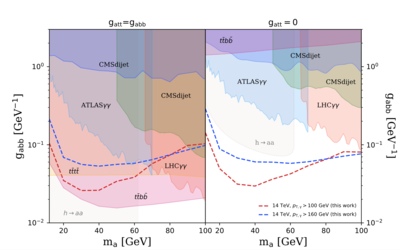
September 13, 2025: Although the main focus of the LHC has been constraining TeV-scale physics, new physics could still be hiding below the electroweak scale: well-motivated dark matter (DM) models predict light scalars, such as axion-like particles (ALPs), as mediators between the Standard Model (SM) and DM. The experimental-theoretical HEP working group Low@LHC, a collaboration fostered through the years by Amidex/OCEVU/IPhU, has recently focused on the exploration of the ALP parameter space. The current direct and indirect searches already constrain strongly the coupling between ALPs and the top quark. By considering models where the ALP dominantly couples to down-type fermions, such as b-quarks, the derived constraints turn out to be weaker, and the prospects to discover ALPs at the High-Luminosity LHC become more compelling. In particular, the recent publication (just accepted by Physical Review D) focuses on the prospects for discovering ALPs at the HL-LHC in events where a photon and two b-quarks are produced. The identification of photons and b-quarks are at the core of the CPPM-ATLAS group expertise.
-
July 31, 2025: News Letter CNRS Nucléaire & Particules #256 (in French): The constraints on the Higgs boson self-coupling are tightening
-
July 8, 2025: Many theories beyond the Standard Model predict the existence of several types of Higgs boson. Just over a year ago, the ATLAS collaboration unveiled the results of a new study on the search for additional Higgs bosons in the final state with two photons and two b-quarks. The CPPM team was the driving force behind this analysis, and a small excess was found in the LHC Run 2 data. An update was presented at the EPS-HEP2025 conference in Marseille, this time including a partial dataset from the Run 3 of the LHC (2022 and 2023). Once again, the CPPM was at the helm of coordination, analysis and writing. Unfortunately, the small excess seems to have disappeared, mainly thanks to a better identification of the b-quark jets, a re-optimisation of the analysis and the inclusion of the new data. The Higgs boson remains the only one in its family, but the search continues!
-
7 to 11 July 2025: The EPS-HEP2025 conference is one of the largest international conference for the particle physics, astroparticle physics, gravitation, and cosmology communities. It took place from 7 to 11 July 2025 at the Palais du Pharo in Marseille. Thomas Strebler, a researcher in the ATLAS group at CPPM, led the organization of the conference, which brought together more than 700 participants.
-
May 26, 2025: ATLAS has submitted in Nature Communications a paper that presents a novel transformer-based flavour tagging algorithm (GN2) which is a paradigm shift from previous approaches. The CPPM team is among the institute which contributed to this important result designed to classify jets based on the flavour of their constituent particles. Its performance is validated in both simulation and collision data. The GN2 algorithm provides substantial benefits for physics analyses involving heavy-flavour jets, such as measurements of Higgs boson pair production in which the group is strongly involved, and demonstrates the impact of advanced machine learning methods in experimental particle physics.
-
May 16, 2025: A new ATLAS result result presented at the recent Higgs Pair workshop marks a significant step forward in the search for di-Higgs production. The study introduces a powerful algorithm to identify boosted Higgs bosons decaying into pairs of hadronically decaying τ-leptons — a crucial signature for the HH→bbττ channel. Building on previous developments for identifying Higgs decays into b and c-quark pairs, the new method leverages detailed information from both charged and neutral jet constituents, achieving remarkable background rejection while maintaining high signal efficiency. This breakthrough benefits directly from the strong involvement of the CPPM group through the ANR-funded DIVE project, which focuses on advanced reconstruction techniques for boosted objects — a cornerstone of Run 3 and HL-LHC Higgs pair analyses.
-
May 12, 2025: The ATLAS experiment has set a new limit on the production of a pair of Higgs bosons decaying to a pair of b-quarks and a pair of photons with data collected in 2022, 2023, and 2024 combined with Run 2 data. This represents the first result from ATLAS with a record integrated luminosity of 308 fb-1. The upper limit is observed to be 3.8 times the Standard Model cross-section at 95% confidence level. The computed cross-section ratio to the predicted cross-section is measured to be 0.9+1.4-1.1, in complete agreement with the Standard Model. This is an important result for ATLAS, setting the stage for more stringent constraints on the Higgs self-coupling with Run 3 data. The results are presented at the Higgs Pairs Workshop this week. The ATLAS group at CPPM contributed significantly to this analysis with involvement in analysis framework development, analysis data production, validation of di-Higgs reconstruction techniques, and the statistical analysis. The group also contributed to the preparation of photon identification efficiency corrections, which are mandatory for this analysis. This result is an achievement for the ATLAS CPPM group after a long-lasting contribution to the main ingredients of this analysis. The CPPM has led the upgrade of the trigger readout path of the liquid argon calorimeter with significant improvements to the photon triggers used in this analysis. Additionally, the group's contribution to the identification of b-jets with ever more powerful algorithms based on state-of-the-art machine learning techniques had a significant impact on the increasing efficiency of selecting the rare HH->bbγγ signal.
-
April 5, 2025: the ALICE, ATLAS, CMS, and LHCb collaborations at CERN’s Large Hadron Collider (LHC) were awarded the Special Breakthrough Prize in Fundamental Physics by the Breakthrough Prize Foundation. These four collaborations, bringing together thousands of researchers from over 70 countries, were recognized for their work based on data collected during the LHC’s second run, up to July 2024. The prize was presented to the spokespersons who led the collaborations during this period, in recognition of their detailed measurements of the Higgs boson’s properties confirming the mechanism of spontaneous symmetry breaking responsible for mass generation, the discovery of new strongly interacting particles, the study of rare processes and matter–antimatter asymmetry, and the exploration of nature at the smallest distance scales and under the most extreme physical conditions made accessible by the LHC. This award highlights the scientific excellence and international leadership of CPPM, through the major contribution of its ATLAS team to the recognized results. It also acknowledges the long-term commitment of many CPPM members, over several decades, to the design, construction, and operation of these experiments. In particular, it underlines the laboratory’s involvement in the construction and operation of the ATLAS liquid argon calorimeter and pixel detector, as well as in scientific computing activities—each being essential contributions to the discoveries honored by this award. These projects, currently undergoing major developments, are pillars of the laboratory’s scientific and technological strategy, with a view toward the Phase 2 upgrades and the High-Luminosity LHC program for at least the next two decades.
-
March 31, 2025: Publication of the Feasibility Study of the FCC: in 2020, the CERN Councel asked for a feasibility report of a Future Circular Collider (FCC) at CERN. This study is also a summary of last years achievements towards FCC project, including not only forseen measurements and searches at FCC, but also accelerators, civil engineering and sustainability. Volume 1 is about physics and detectors. The other volumes concern accelarators and civil engineering.
-
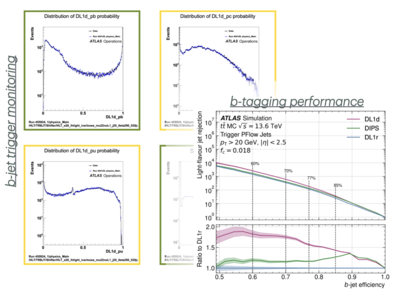
Januray 20, 2025: In the first years of Run 3 data-taking, the new neural network-based b-tagging algorithms led to a significant increase in the ATLAS trigger performance compared to Run 2. This is detailed in a paper recently released by the ATLAS collaboration and co-written by one CPPM-ATLAS member, which also sheds light on the CPPM's key role in the success of b-tagging at trigger level since Run 1: its integration into the trigger software infrastructure, calibration, monitoring, and commissioning studies. A new set of improvements allowed ATLAS to collect di-Higgs events in a final state with b-anti-b quarks and tau-lepton pairs with a signal efficiency increase of ~50% compared to Run 2. The CPPM is part of the ATLAS HH team responsible for analyzing this data.
-
December 19, 2024: The transition to the High-Luminosity phase of the LHC (HL-LHC), with up to 200 interactions per beam crossing, presents unprecedented challenges for the reconstruction of charged particle trajectories, which is essential for the ATLAS physics program. The new Inner Tracker (ITk), made entirely of silicon, will replace the current Inner Detector (ID) during Long Shutdown 3 (2026-2030). The latest paper submitted by the ATLAS collaboration details the expected performance of the ITk in terms of track reconstruction. The ATLAS group at CPPM has played a central role in these performance studies. By combining its expertise in track reconstruction with its significant involvement in the design and construction of the ITk, the group contributes to pushing the boundaries of instrumentation and data analysis. These efforts highlight CPPM’s leading role in enhancing ATLAS’s performance for the years to come, paving the way for new discoveries in high-energy particle physics during the LHC’s high-luminosity phase, which will begin in 2030.
-
July 22nd, 2024: The ATLAS group in CPPM has been involved for many years on the search, the observation and then the study of Higgs production in association with a top quark pair (ttH). The very heavy mass of the quark top (as heavy as a gold atom!) could hint to the fact that it plays a peculiar role with respect to the Higgs boson. The ATLAS collaboration has published its final study on the whole Run 2 sample (2015-2018), in which the Higgs boson decays to 2 b-quarks. This measurement, with a precision of about 25%, is in agreement with the Standard Model prediction, and also at high transverse momentum of the Higgs boson. The results of this analysis could hence not prove the existence of a deviation with respect to standard model predictions, that still resists our attempts to put it in default. The CPPM team was a major contributor to this analysis, in particular with supervised learning technique developments and deep neural networks. Ziyu Guo (PhD defended in 2019) had introduced recurrent neural networks and the use of low level variables. Neelam Kumari had followed and developped deep sets (PhD defended in 2022). This underlines the time needed to pursue this type of complex analysis. This publication concludes CPPM implication on ttH analysis, to focus on di-Higgs analysis at Run 3 and at HL-LHC.
-
June 24th, 2024: Study of the production of two Higgs boson, known as "di-Higgs" production, allows to measure the Higgs boson "self-coupling" strength - a fundamental aspect of the Standard Model linking the Higgs mechanisms and the stability of our universe. But the measure of the di-Higgs production is a particularly difficult one. This process is very rare, approx. 1000 times less frequent that the single Higgs production. To maximize their chances, ATLAS researchers study the most promizing desintegration of the two Higgs boson: H(→bb)H(→ττ), H(→bb)H(→γγ), H(→bb)H(→bb), H(→bb)H(→ll+ETmiss), HH→leptons+X, all having its advantages and drawbacks. Combining these 5 studies to enhance their statistical significance, the ATLAS collaboration has obtained the most sensitive probe to the di-Higgs production and to the Higgs self-coupling. This analysis, submitted to the PRL journal this week, excludes di-Higgs production cross-section that are more than 2.9 times above the Standard Model prediction. Researchers have also constrained the magnitude of the Higgs boson self-coupling with respect to the Standard Model prediction, which stays for now compatible with the predictions. LHC Run 3 is now on-going and could more than double the data sample collected, opening new perspectives for these searches.
-
June, 2024: The CPPM team is continuing the development of the new LASP (Liquid Argon Signal Processor) electronic board for data processing from the Liquid Argon Calorimeter (LAr). This board will be installed during the second phase of the ATLAS detector upgrade. The CPPM LAr team has completed the electronic schematics for the LASP board, which successfully passed an ATLAS preliminary design review, validating the construction of the board’s first prototype. This marks the beginning of the final stage of the board's design, focusing on routing before building the initial prototypes.
-
May 20th, 2024: Important progresses have been done these last weeks concerning the ITk-Pixel project, both at the collaboration level and at the local level. The "global mechanics" Final Design Report concerning all assembly procedures of the mechanical structures sheltering the modules with the goal to construct the whole detector, has been "passed successfully with recommandations". At the local level, pre-production is advancing : The team members learn the complex procedures enabling to mount modules on mechanical structures (photo) with the help of the "itinerant stave" that contains all the necessary elements and travels between the various labs of the collaboration. The module test system (photo) has passed its qualification phase and first digital modules could be tested. These progresses will be shown and discussed next week in Clermont-Ferrand at the fourth "Journées Upgrade ATLAS-France". In the end, our team will be in charge to mount approximately 1000 modules on structures the next years that will form the future ATLAS tracker for the high luminosity phase of the LHC.
-
May 6th, 2024: 12 years after the Higgs boson discovery, most of its properties have been measured, but the Higgs boson self-coupling measurement remains a priority of the ATLAS collaboration and the CPPM team, in particular in the final state with two photons and two b-quarks. Numerous theories also predict the existence of multiple Higgs bosons that we could find following the same final state. A new article was thus recently submitted for publication and presented at the Moriond EW conference. This anaylsis, derived from the one on Higgs self-coupling and using the complete data sample from LHC Run 2, was done by CPPM group members and collaborators (with contribution of a visiting student from Shanghai Jiao Tong university), L2IT in Toulouse and the KTH institute from Stockholm university. A small excess has been recorded with a local significance of 3.5 standard deviations, but only 2.0 standard deviations if one corrects for the fact that a large number of masses were tested. This gives an extra motivation to follow this analysis with the Run 3 data!
-
May, 2024: The start of the LHC in 2024 is marked by the implementation of the new digital trigger system for the Liquid Argon Calorimeter (LAr), which has become the default trigger for all physics objects. The CPPM team has played a major role in the hardware, firmware, and software development of this trigger, as well as in its commissioning. This achievement represents the successful completion of a significant project in which the CPPM held critical responsibilities. The LAr system is operating exceptionally well (see this link), with an efficiency of 99.9%. The CPPM also contributes significantly to the operation and data quality control of this system.
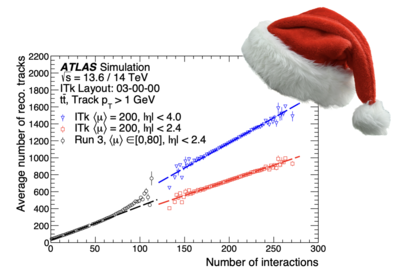
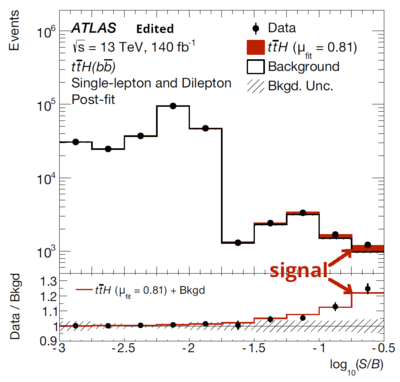
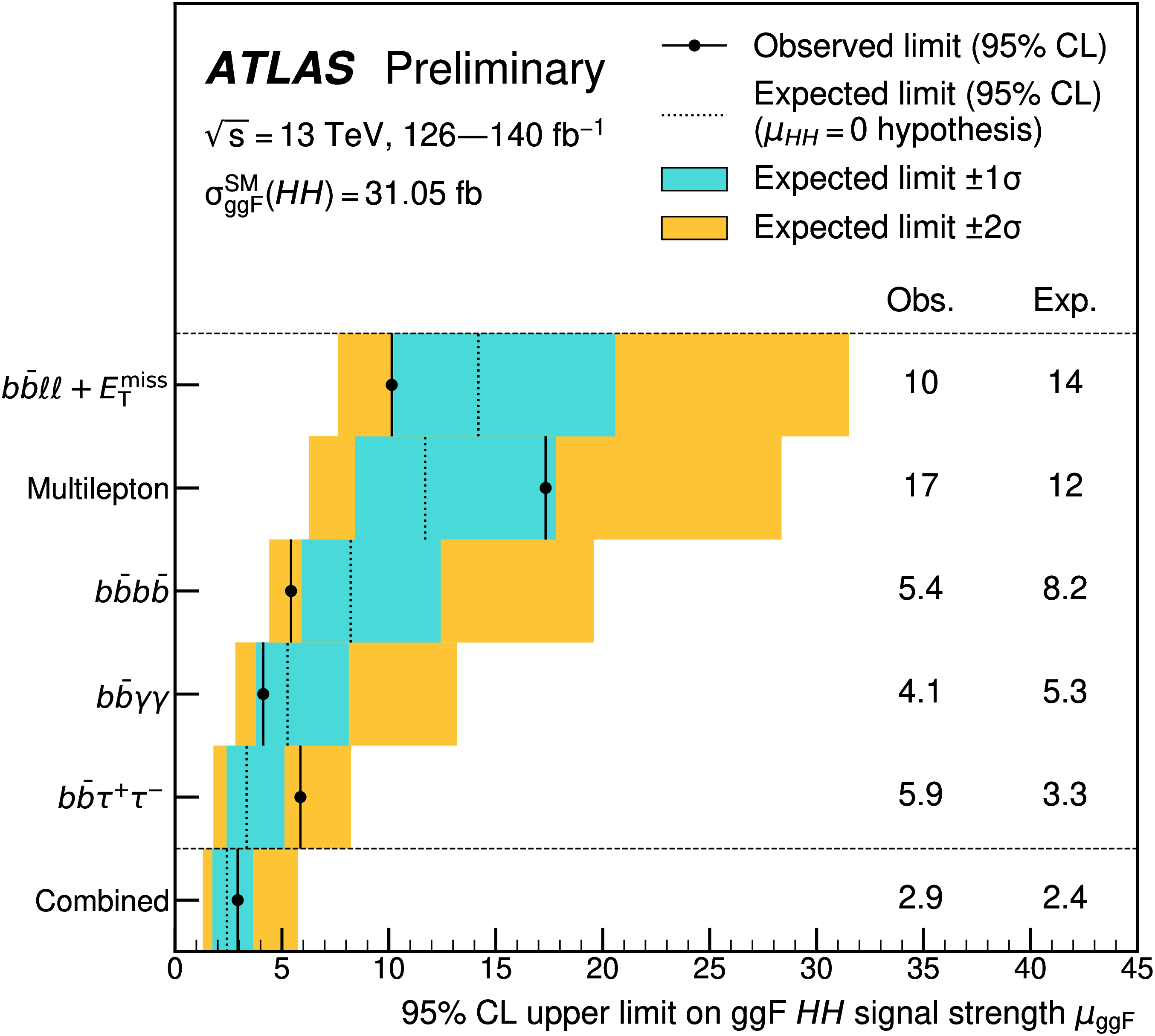
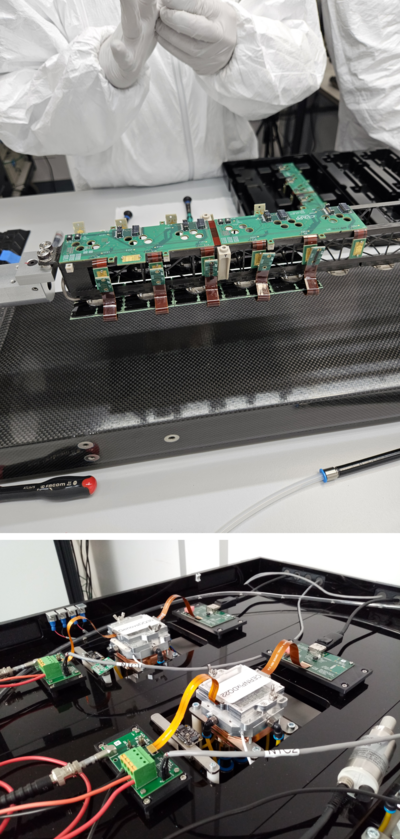
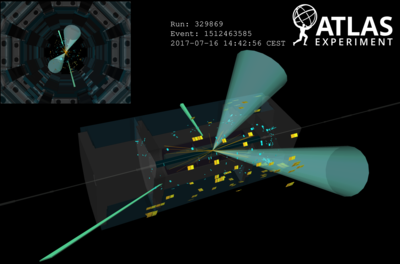
-
December 2023: Publication of the final di-Higgs results with Run 2 data, and start of the Run 3 data analysis. Two ATLAS CPPM group members (Thomas Strebler and Timothée Theveneaux-Pelzer) become coordinators within the di-Higgs group.
-
October 24th, 2023: The CNRS crystal medal was awarded today to Eric Vigeolas, research engineer in mecanics and mecatronics, and project leader on the ATLAS ITk tracker, for the ATLAS CPPM team.
-
October 2023: The ITkPixV2 ASIC for the ATLAS ITk detector (HL-LHC project) is back from the foundry. On top of many tests to be performed in laboratories, several testing campains under proton or ion flux are already planned for beginning of 2024, to test the circuit in harsh conditions close to those of HL-LHC (under our team supervision).
-
April 2023: The new higher granularity e-gamma digital trigger based on the Liquid Argon Calorimeter, whose deployment was the goal of the Phase-I Calorimeter upgrade and put in place with large contributions from our team, has now become the new default trigger system for ATLAS, outperforming the performances of the old analog trigger system.
-
March 27th, 2023: A large number of new ATLAS physics results have been presented during the winter conferences: Observation of the
four-top-quark production, measurement of the ttW production, most precise single measurement of the strong interaction "alpha_s" coupling, improvement on the W mass measurement W... Some beautiful results from the ATLAS experiment in a context of restart of the Run 3 phase of the LHC. -
March 22nd, 2023: A major milestone of the ATLAS ITk project has been reached today. The very complex ITkPixV2 Integrated Circuit (IC), production version for the ATLAS pixel detector has been submitted for production. The IC will be used for the Run 4 of the ATLAS experiment in the new pixel detector (High Luminosity LHC phase, post-2028). It is the result of the effort of an almost 10-year long development by teams from more than 20 institutes worldwide, in the framework of the CERN RD53 project, among which the ATLAS CPPM team.
-
March 14th-15th 2023: The first DRD7 workshop (ECFA process) "Electronics and On-Detector Processing" has taken place in CERN with implication from the team members for our activities in micro-electronics, as well as 250-300 participants over the two days. The ECFA process will structure R&D developments for particle physics at the european level for the next decade.
-
October 11th, 2022: Elisabeth Petit, researcher in the CPPM team, receives the CNRS bronze medal, a reward that underlines her implication in Higgs boson studies but also in the upgrade project of the pixel detector of ATLAS Inner Tracker for the High Luminosity LHC phase.
-
August 22nd, 2022: Intensity of the Higgs boson coupling as a function of the Z and W boson masses, as well of the masses of the muons, taus, and charm, bottom and top quarks. This summary plot shows the excellent agreement of the experimental data with the theory developed by Brout-Englert-Higgs to account for the electroweak symmetry breaking mechanism and the generation of the masses of bosons and fermions.
-
July 6th, 2022: At the occasion of the 10-year anniversary of the Higgs boson discovery, a colloquium was organized by the national institute IN2P3 with a contribution of Elisabeth Petit, researcher in the CPPM team.
-
July 5th, 2022: Today, the LHC has seen its first proton-proton collisions at the unprecedented center of mass energy of 13.6 TeV. After three years of stop for upgrade and maintenance work, it is the official kick-off of the Run 3 phase of operation for the LHC, during which further test of the Standard Model (SM) will be pursued in the Higgs sector and with searches for extensions to the SM of particles.
-
June 28th, 2022: Elisabeth Petit, researcher in the ATLAS CPPM team, is invited in « la méthode scientifique », the french radio program of France Culture.
-
June the 2nd, 2022: Georges Aad, researcher in the CPPMATLAS team, has received an « Outstanding Achievement Award 2022 », a prize given by the ATLAS collaboration for «exceptional contribution to the digital electronic system of the ATLAS Liquid Argon calorimeter trigger», a phase 1 upgrade installed and starting operation for the LHC Run 3, to efficiently treat increased event pile-up related to the higher luminosity of LHC. This prize acknowledges and rewards the importance and the quality of the CPPM ATLAS team work in this project. The finalization of this upgrade is on-going and the CPPM, with engineers, students and physicists is responsible for several key aspects. The new system is operational and collects the first collision data that the LHC has just started producing on May 28th, 2022 as Run 3 is now starting.
-
April 18th, 2022: To prepare the production phase of the future ATLAS pixel detector for HL-LHC (ITK Pixel Detector project), the « mechanics and production » team has developed an automated glue deposition method, for the cells that shelter the modules before integration in the mechanical structures of the detector. This highly reliable method allows to deposit a quantity of glue with a 4% accuracy for 400 mg of glue used. This is important in order not to degrade the detector’s performance and guaranty a lifetime above 10 years in-situ. The production phase for the detector will take place from 2024 to 2026 and our team will handle the integration of about 50 modules per month during this phase.
-
March, 2022: The ATLAS and CMS Collaborations have released as an input for the US Snowmass prospective exercise a common White Paper summarizing the most recent physics projection results for the High-Luminosity phase of the LHC (HL-LHC). The CPPM group was in particular directly involved in the prospect result related to the search for di-Higgs production at HL-LHC, which is one of the main cornerstones of the ATLAS HL-LHC physics program. Those results have confirmed that a 3-sigma evidence with ATLAS data and a 5-sigma observation combining with CMS is definitely by the end of HL-LHC data-taking.
-
December 13th-16th, 2021: 13th FCPPL “France-China Particle Physics laboratory” workshop, in which the group was represented with presentations giving status reports of activities in the framework of several collaborations between our team and partner teams in China.
-
November 22nd, 2021: The CPPM ATLAS team has been involved for many years in the search, the observation, and then the study of theHiggs boson production with a top quark pair. The ATLAS collaboration has just published a new study in which the Higgs boson decays to a b quark pair. The Higgs field gives mass to elementary particles by means of its interaction. The very heavy mass of the top quark (almost as heavy as a gold atom!) hints to the top quark having a special relation to the Higgs, and the study of this relation is the topic of these analyses. For the first time in this channel, the analysis is performed as a function of the Higgs boson transverse momentum. The CPPM team has deeply contributed to this study, in particular with the development of machine learning techniques.
-
November 2021: Beam circulation has started in the LHC at the injection energy (2x450 GeV) in stable mode. The ATLAS detector registers new data and in particular with its Liquid Argon (LAr) Calorimeter. The LAr calorimeter has seen a major update during the recent long shutdown, for which the CPPM team was extremely active.The LAr system has started transmitting data for the first time with its new updated readout systemand in particular in direction of the calorimeter first level trigger. This is an important milestone towards Run 3, which starts in spring 2022.
-
October 21st 2021: Publication of the ECFA document(European Committee for Future Accelerators) concerning detector R&D perspectives and organization « Detector Research and Development Roadmap ». This document will structure detector R&D at colliders for the years to come.
-
End of October, 2021:Protons are back in the LHC !After more than two years of maintenance and updating of the collider and the detectors, LHC pilot runs are currently ongoing. The ATLAS detector recorded “Splash” events (a flux of particles resulting from the interaction between the beams and a collimator located before the detector). The first proton frictions happened at the LHC injection energy (450 GeV per beam) in stable mode in the last week of October. This has allowed ATLAS to register these first data and to validate its good functioning. In June 2022 this will be the start of Run 3, for which the LHC will raise its center of mass energy from 13 to 13.6 TeV.
-
June 2021: Publication on the configuration and the performances of the Run 2 b-jet trigger. The Run 2 High Level Trigger (HLT) reduces the data rate from 100 kHz at the level 1 trigger output to save events on disk at a rate of about 1 kHz. The hadronic jets containing b-quarks are identified (b-tagged) in the HLT by exploiting the properties of b-hadrons, which have a relatively long lifetime, of the order of 1.5 ps, to reconstruct secondary vertices typically located few mm away from the hard-scatter interaction. The b-jet trigger software was redesigned to improve stability under increasingly harsh pile-up conditions. These changes, together with improved tracking performance in the trigger, the installation of the insertable B-layer for Run 2, and the usage of the most advanced algorithms lead to significantly improved performance compared to Run 1. The CPPM group has contributed to the success of the Run 2 b-jet trigger with multiples responsibilities (monitoring, software development and validation, calibration).
-
February 2021:Probing for Single Event Effects (SEE) at the GANIL accelerator. The structures that were tested are memory blocks conceived to be SEE-resistant. They use hardening methods such as data and control line redundancy, memory triplication, DICE cells, physical layout level separation…. The tested memories are implemented in three different technologies (TJ180, AMS180 and LF150). This work is done in the framework of the DICE master project and of the RD50 collaboration.
-
End march 2021: The ATLAS collaboration has released anew result on the Higgs boson self-interaction, looking for events containing a Higgs boson pair. This process is very rare, about 1000 times rarer than the production of a Higgs boson alone. Events where one Higgs boson decays to two photons and the other Higgs bosons to two bottom quarks are a powerful handle to search for Higgs boson pair production. New analysis technics were developed to search for this rare process (only 12 such events would have been produced at the LHC so far) by several teams, including the ATLAS team of CPPM. Limits were set on how often pairs of Higgs bosons are produced, at 4.1 times the Standard Model prediction. This result sets the world's best limits on the Higgs self-coupling. But we will need much more data to precisely measure the Higgs self-coupling and to see whether it agrees with the Standard Model prediction. The High-Luminosity upgrade of the LHC plans to deliver a dataset 20 times larger than the one we used for this study. The ATLAS group at CPPM is deeply involved in the upgrade of the detectors for this new phase.
-
February 2021:Emmanuel Monnier has been re-elected as ATLAS Liquid Argon Calorimeter Project Leader for two years, with his new terms starting on March 1st 2021.
-
October, 29th 2020: New results concerning the production of the Higgs boson in association to a top quark pair (ttH) were shown at the Higgs 2020 conference. This analysis concerns the complete ATLAS Run 2 set (139 fb-1) and benefited from the strong work from several members of our group.
-
October, 8th 2020: Submission to the European Physical Journal C of the paper "Search for phenomena beyond the Standard Model in events with large b-jet multiplicity using the ATLAS detector at the LHC". This analysis, to which our group is a strong contributor, allows to establish model-independent limits to the presence of new physics in events with high b-jet multiplicity and, at the same time, to constrain natural supersymmetric models violating the R-Parity.
-
End of March 2020: While the virus’ proliferation is spreading rapidly in different parts of the world, theresearchers mobilize international action in response to the new coronavirus. The grid computing infrastructure at CPPM that is mainly used during normal time by the LHC experiments ATLAS and LHCb in the context of WLCG collaboration (Worldwide LHC Computing Grid) is now ready to receive more jobs from biomedical research projects related to Covid-19 research studies. We work in coordination with the virtual organisation biomed and INSERM computing for researchers to have access to our ressources.
-
March, 30th 2020: TheCPPM grid computing infrastructure for ATLAS is now considered as a Nucleus. The Nucleus sites are the main processing sites receiving data directly staged at CC-IN2P3 (Tier-1) but processed outside CC-IN2P3. To have this Tier-1 like status, the grid site needs to have enough storage, very good availability and processing efficiency for data in addition to a good network bandwidth. So far, only the LAPP Tier-2 had this status in France. It is therefore a recognition for the CPPM Tier 2.
-
March, 17th 2020: On March 17 2020,the ITkPixV1 chip was submitted to the TSMC foundry for production. With a surface area of more than 4 cm², this chip has been designed in the 65 nm CMOS process and will tolerate an ionizing dose of more than 500 Mrad. It contains more than 1/2 billion transistors and 153600 pixels of 50x50 µm² organized in 2400 regions of 8x8 pixels. This is the culmination of nearly 8 years of work by CERN's RD53 collaboration, to which the CPPM's ATLAS team has been a major contributor since its foundation. This is the pre-production version of the chip which will equip, in more than 33,000 units, the 5 internal pixel layers of the future ATLAS post-2026 trajectograph. This is a major step towards improving the ATLAS detector for the High Luminosity phase of CERN's Large Hadron Collider, which has now been completed.
-
January 2020: TheCERN Yellow Report "Physics of the HL-LHC, and perspectives at the HE-LHC"is now published. This report summarizes the outcome of five working groups that have studied the physics potential of the High-Luminosity phase of the LHC (14 TeV HL-LHC) as well as perspectives for a future possible High Energy LHC (27 TeV HE-LHC), and covers topics such as: Standard Model measurements, Higgs boson properties, flavor physics with heavy quarks, QCD at high density and temperature, and searches for phenomena Beyond the Standard Model. The ~1400 pages report can be found at CERN Yellow Report: Physics of the HL-LHC, and HE-LHC perspectives.
-
July 2019: 64 ATLAS contributions given at the European Physics Society High Energy Physics 2019 conference in Ghent, Belgium. ATLAS highlights can be found at http://atlas.cern/updates/atlas-news/eps-2019-highlights .
-
Spring 2019: Success of the AAP (Call for Project) of the Aix-Marseille AMIDEX fundation forthe AIDAQ project: This project deals with the implementation of artificial intelligence algorithms on FPGAs (in particular of neural networks) for the real time computation of the energies deposited in the ATLAS Liquid Argon Calorimeter.
-
January 2019 - now:LHC Long Shutdown 2 and on-going ATLAS detector Phase I Upgrade targetting Run 3 data taking. Our group is a strong contributor to the installation of the new readout electronics for the electromagnetic calorimeter.
-
December 2018: End of proton-proton data taking (Run 2 Phase), with a record collected luminosity of 139 fb-1 which will lead to precision analysis of the Higgs boson properties, as well as searches for New Physics in an extended mass range.
-
13th November 2018:Aix-Marseille Thesis award 2017 given to Thomas Calvet. This work comes in recognition of his excellent research work on the assocatied Higgs production with a quark top pair where the Higgs decays to two bottom quarks (so-called ttH(bb) channel), and the b jet tagging with the ATLAS experiment at the LHC. https://hal-amu.archives-ouvertes.fr/tel-01681700/
-
4th June 2018: publication of theproduction of the Higgs boson with a pair of top quarks (ttH) by the ATLAS experiment, with a significant contribution by the CPPM group. https://atlas.web.cern.ch/Atlas/GROUPS/PHYSICS/PAPERS/HIGG-2018-13/
-
24th December 2017:evidence seen by ATLAS of the ttH associate production. https://atlas.web.cern.ch/Atlas/GROUPS/PHYSICS/PAPERS/HIGG-2017-02/
-
2017:finalization of the Phase 2 Upgrade TDRs, including those on calorimetry and ITk pixels.
-
April 2016:first proton collisions in ATLAS for 2016
-
3rd June 2015: stable beams in the LHC, first collisions at 13 TeV and first signals in the new IBL layer!The beginning of Run 2...
-
9th December 9, 2014:A first LHC magnet reaches the current needed to communicate an energy of 6.5 TeV to protons, paving the way for the LHC Run 2 data taking to begin in spring 2015.
-
June 2014: Thefirst 3D pixel circuit for ATLAS, designed at CPPM, is qualified to withstand the radiation dose expected at HL-LHC.
-
7th May 2014:insertion of the fourth layer of IBL pixels in ATLASfor which the CPPM made major contributions to the FE-I4 electronic readout chip and to mechanics.
-
October 2013:Nobel Prize in Physics awarded to F. Englert and P. Higgs.
-
4th July 2012: announcement of thediscovery of the Higgs boson by ATLAS (and CMS).
-
17th December 2012:end of the LHC Run 1 data collection period.
-
30th March 2010:first high-energy proton collisions (7 TeV) in the LHC.

Belle II
The Belle II experiment is installed at the e+e- SuperKEKB accelarator in Japan. Its goal is to study the properties of beauty and charmed mesons as well as tau leptons, as a way to search for physics beyond the Standard Model.
The physics data taking with a complete detector started in spring 2019 with the final goal to collect a dataset 50 times bigger than the previous experiment, Belle.
The collaboration has more than 1000 members. France participates through four laboratories: IJCLab, IPHC, cc-IN2P3 and CPPM. The international research lab TYL was also created in 2023 by IN2P3 at KEK.
The interests of CPPM are focused on data analysis involving tau leptons: tau lepton flavor violating decays and rare decays of B to tau. These activities are developed thanks to European fundings obtained by Justine Serrano (ERC consolidator grant ’NEPAL’) The group is also involved in tracking studies an operation of the silicon vertex detector (SVD). We also particpate to the design of the OBELIX chip for the upgrade of the vertex detector.
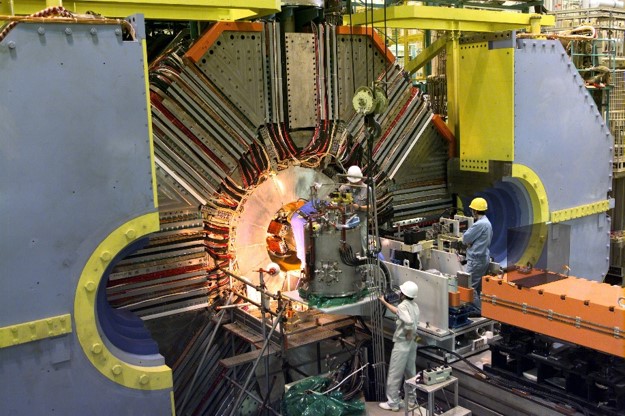

Researchers and Research professors
- Justine Serrano (Team responsible)
- Vitalii Lisovskyi
- Giampiero Mancinelli
- Karim Trabelsi
- Vidya Sagar Vobbilisetti
PHD students and post-doctoral fellows
Engineers and Technicians
Articles
2026: 2 articles
- Operational experience and performance of the Silicon Vertex Detector after the first long shutdown of Belle II, K. Ravindran et al., Belle-II SVD Collaboration, Nucl. Instrum. Meth. A 1081 (2026) 170834
- Search for the decay using data from the Belle and Belle II experiments, M. Abumusabh et al., Belle2 Collaboration, Phys. Rev. Lett 137 (2026) 051805
2025: 30 articles
- Measurement of the integrated luminosity of data samples collected during 2019-2022 by the Belle II experiment, Adachi, I. et al., Belle2 Collaboration, Chin. Phys. C 49 (2025) 013001
- Measurement of asymmetries in decays at Belle II, Adachi, I. et al., Belle2 Collaboration, Phys. Rev. Lett 134 (2025) 011802
- Measurement of asymmetries in decays at Belle II, Adachi, I. et al., Belle2 Collaboration, Phys. Rev. Lett 134 (2025) 011802
- Measurement of branching fractions, CP asymmetry, and isospin asymmetry for decays using Belle and Belle II data, Adachi, I. et al., Belle2 Collaboration, Phys. Rev. D 111 (2025) L071103
- Determination of from simultaneous measurements of untagged and decays, Adachi, I. et al., Belle2 Collaboration, Phys. Rev. D 111 (2025) 112009
- Search for violation in decays using triple and quadruple products, Aggarwal, L. et al., indéfini, J. High Energy Phys. 04 (2025) 036
- Search for violation in decays using triple and quadruple products, Aggarwal, L. et al., Belle2 Collaboration, J. High Energy Phys. 04 (2025) 036
- Observation of time-dependent violation and measurement of the branching fraction of decays, Adachi, I. et al., Belle2 Collaboration, Phys. Rev. D 111 (2025) 012011
- Model-independent measurement of - mixing parameters in decays at Belle and Belle II, Adachi, Ichiro et al., Belle2 Collaboration, Phys. Rev. D 111 (2025) 112011
- Measurement of the time-integrated CP asymmetry in decays using Belle and Belle II data, Adachi, I. et al., indéfini, Phys. Rev. D 111 (2025) 012015
- Measurement of decays at Belle II, Adachi, I. et al., Belle2 Collaboration, J. High Energy Phys. 09 (2025) 024
- Measurement of the inclusive branching fractions for decays into mesons via hadronic tagging, Adachi, I. et al., Belle2 Collaboration, J. High Energy Phys. 04 (2025) 114
- Observations of the singly Cabibbo-suppressed decays , , and at Belle and Belle II, Adachi, I. et al., Belle2 Collaboration, J. High Energy Phys. 03 (2025) 061
- Observation of the decay at Belle II, Adachi, I. et al., Belle2 Collaboration, Phys. Rev. D 111 (2025) 032012
- Measurement of the branching fraction and $\it CP$-violating asymmetry of the decay using million bottom-antibottom meson pairs in Belle II data, I. Adachi et al., Belle2 Collaboration, Phys. Rev. D 111 (2025) L071102
- Search for lepton flavor-violating decay modes with hadronic -tagging at Belle and Belle II, Adachi, Ichiro et al., Belle2 Collaboration, Phys. Rev. Lett 135 (2025) 041801
- Measurement of the branching fraction, polarization, and time-dependent asymmetry in decays and constraint on the CKM angle , Adachi, I. et al., Belle2 Collaboration, Phys. Rev. D 111 (2025) 092001
- Measurement of branching fraction with a hadronic tagging method at Belle II, Adachi, I. et al., Belle2 Collaboration, Phys. Rev. D 112 (2025) 072002
- Search for and in Inclusive Decays at Belle, Adachi, I. et al., Belle2 Collaboration, Phys. Rev. Lett 135 (2025) 041901
- Measurement of the Branching Fraction of at Belle, Adachi, I. et al., Belle2 Collaboration, Phys. Rev. D 112 (2025) 012013
- Measurements of the branching fractions of , , and at Belle and Belle II, Adachi, I. et al., Belle2 Collaboration, J. High Energy Phys. 08 (2025) 195
- Search for decays at the Belle II experiment, Adachi, I. et al., Belle2 Collaboration, Phys. Rev. Lett 135 (2025) 151801
- Test of lepton flavor universality with measurements of and using semileptonic tagging at the Belle II experiment, Adachi, I. et al., Belle2 Collaboration, Phys. Rev. D 112 (2025) 032010
- Measurement of the time-integrated asymmetry in $D^0 \to K^0_{\rm S} K^0_{\rm S}$ decays using opposite-side flavor tagging at Belle and Belle II, Adachi, I. et al., Belle2 Collaboration, Phys. Rev. D 112 (2025) 012017
- Search for lepton-flavor-violating decays at Belle and Belle II, Adachi, I. et al., Belle2 Collaboration, J. High Energy Phys. 08 (2025) 092
- Measurement of the time-integrated asymmetry in decays at Belle II, Adachi, I. et al., Belle2 Collaboration, Phys. Rev. D 112 (2025) 012006
- Search for lepton flavor-violating decay modes () with hadronic B-tagging at Belle and Belle II, Adachi, I. et al., Belle2 Collaboration, J. High Energy Phys. 08 (2025) 184
- Search for a dark Higgs boson produced in association with inelastic dark matter at the Belle II experiment, Adachi, I. et al., Belle2 Collaboration, Phys. Rev. Lett 135 (2025) 131801
- Measurement of the CP asymmetry in decays at Belle II, Adachi, Ichiro et al., Belle2 Collaboration, Phys. Rev. D 112 (2025) L031101
- Observation of the decays $B^{+} \to Σ_{c}(2455)^{++} \overlineΞ_{c}^{-}$ and $B^{0} \to Σ_{c}(2455)^{0} \overlineΞ_{c}^{0}$, Abumusabh, M. et al., Belle2 Collaboration, Phys. Rev. D 112 (2025) L051101
2024: 24 articles
- Measurement of branching-fraction ratios and asymmetries in decays at Belle and Belle II, Adachi, I. et al., indéfini, J. High Energy Phys. 05 (2024) 212
- Measurement of branching fractions and direct CP asymmetries for and $ B $ decays at Belle II, Adachi, I. et al., Belle2 Collaboration, Phys. Rev. D 109 (2024) 012001
- First measurement of as an inclusive test of the anomaly, Adachi, I. et al., Belle2 Collaboration, Phys. Rev. Lett 132 (2024) 211804
- Evidence for Decays, Adachi, I. et al., Belle2 Collaboration, Phys. Rev. D 109 (2024) 112006
- Search for the and processes at , Adachi, I. et al., Belle2 Collaboration, Phys. Rev. D 109 (2024) 072013
- A test of lepton flavor universality with a measurement of using hadronic tagging at the Belle II experiment, Adachi, I. et al., Belle2 Collaboration, Phys. Rev. D 110 (2024) 072020
- Study of decays to final states at Belle II, Adachi, I. et al., Belle2 Collaboration, J. High Energy Phys. 07 (2024) 116
- Measurement of asymmetries in decays at Belle II, Adachi, I. et al., Belle2 Collaboration, Phys. Rev. D 110 (2024) 112002
- The DMAPS upgrade of the Belle II vertex detector, M. Babeluk et al., Belle2 Collaboration, Nucl. Instrum. Meth. A 1064 (2024) 169428
- The silicon vertex detector of the Belle II experiment, A. Gabrielli et al., Belle-II SVD Collaboration, Nucl. Instrum. Meth. A 1064 (2024) 169401
- A new graph-neural-network flavor tagger for Belle II and measurement of in decays, Adachi, I. et al., Belle2 Collaboration, Phys. Rev. D 110 (2024) 012001
- Measurement of asymmetries in decays at Belle II, Adachi, I. et al., Belle2 Collaboration, Phys. Rev. D 109 (2024) 112020
- Search for a resonance in four-muon final states at Belle II, Adachi, I. et al., Belle2 Collaboration, Phys. Rev. D 109 (2024) 112015
- Measurement of the cross section in the energy range 0.62-3.50 GeV at Belle II, Adachi, I. et al., Belle2 Collaboration, Phys. Rev. D 110 (2024) 112005
- Search for rare transitions at Belle, Adachi, I. et al., indéfini, Phys. Rev. Lett 133 (2024) 101804
- Measurement of the branching fraction of the decay at Belle II, Adachi, I. et al., Belle2 Collaboration, Phys. Rev. D 109 (2024) L111103
- Determination of the CKM angle from a combination of Belle and Belle II results, Adachi, I. et al., indéfini, J. High Energy Phys. 10 (2024) 143
- Search for lepton-flavor-violating decays at Belle II, Adachi, I. et al., Belle2 Collaboration, J. High Energy Phys. 09 (2024) 062
- Test of light-lepton universality in decays with the Belle II experiment, I. Adachi et al., Belle2 Collaboration, J. High Energy Phys. 08 (2024) 205
- Measurement of the energy dependence of the , , and cross sections at Belle~II, Adachi, I. et al., Belle2 Collaboration, J. High Energy Phys. 10 (2024) 114
- Search for the decay using Belle and Belle II data, Adachi, I. et al., indéfini, Phys. Rev. D 110 (2024) L031106
- Measurements of the branching fractions of , , and and asymmetry parameter of , Adachi, I. et al., Belle2 Collaboration, J. High Energy Phys. 10 (2024) 045
- Measurement of the branching fractions of and decays at Belle II, I. Adachi et al., Belle2 Collaboration, J. High Energy Phys. 08 (2024) 206
- Search for the baryon number and lepton number violating decays and at Belle II, Adachi, I. et al., Belle2 Collaboration, Phys. Rev. D 110 (2024) 112003
Conference proceedings
2027: 1 conference proceeding
2026: 6 conference proceedings
- A Graph Neural Network for decays reconstruction at Belle II, J. Cerasoli, F. Bernlochner, T. Boeckh, G. Dujany, P. Goldenzweig, M. Götz, J. Kahn, L. Reuter, A. Streit, O. Taubert, A. Thaller, I. Tsaklidis, J. Phys. Conf. Ser., 3206,21th International Workshop on Advanced Computing and Analysis Techniques in Physics Research (2026) 012106, Bari, Italy, 24-28 Oct 2022
- Readout concept of the future Belle II vertex detector, M. Babeluk, T. Bergauer, M. Friedl, C. Irmler, B. Pilsl, C. Schwanda, L. Gaioni, V. Re, E. Riceputi, G. Traversi, S. Giroletti, L. Ratti, G. F. Benfratello, S. Bettarini, F. Bosi, G. Casarosa, L. Corona, F. Forti, A. Gabrielli, M. Massa, L. Massaccesi, M. Minuti, A. Moggi, S. Mondal, G. Rizzo, A. Taffara, V. Vobbilisetti, M. Barbero, P. Barrillon, R. Boudagga, P. Breugnon, D. Fougeron, P. Pangaud, J. Serrano, D. Xu, D. Auguste, J. Bonis, Y. Peinaud, M. Winter, J. Baudot, G. Bertolone, A. Dorokhov, G. Dujany, L. Federici, C. Finck, A. Himmi, C. Hu-Guo, A. Kumar, M. Maushart, F. Morel, H. Pham, I. Ripp-Baudot, R. Sefri, P. Stavroulakis, I. Valin, F. Bernlochner, C. Bespin, J. Dingfelder, H. Krüger, L. Schall, M. Vogt, M. Karagounis, Y. Buch, A. Frey, B. Schwenker, M. Schwickardi, T. Hara, D. Jeans, T. Kishishita, K. R. Nakamura, Y. Okazaki, T. Higuchi, Y. Onuki, S. Wang, C. Lacasta, C. Marinas, J. Mazorra de Cos, L. Molina-Bueno, A. Bevan, M. Bona, D. Howgill, W. Song, J. Gong, X. Gao, A. Fernandez Prieto, A. Gallas Torreira, J. Instrum, 21,Topical Workshop on Electronics for Particle Physics (2026) C04023, Rethymno, Greece, 6-10 Oct 2025
- Operational experience and performance of the Silicon Vertex Detector after the first long shutdown of Belle II, K. Adamczyk, H. Aihara, K. Amos, S. Bacher, S. Bahinipati, J. Baudot, P. K. Behera, S. Bettarini, A. Bozek, F. Buchsteiner, G. Casarosa, C. Cheshta, L. Corona, S. B. Das, G. Dujany, C. Finck, F. Forti, M. Friedl, A. Gabrielli, V. Gautam, B. Gobbo, K. Hara, T. Higuchi, C. Irmler, A. Ishikawa, M. Kaleta, A. B. Kaliyar, K. H. Kang, R. Kumar, K. Lalwani, J. Libby, V. Lisovskyi, L. Massaccesi, G. B. Mohanty, K. R. Nakamura, Z. Natkaniec, Y. Onuki, F. Otani, A. Paladino, V. Raj, K. Ravindran, J. U. Rehman, I. Ripp-Baudot, G. Rizzo, C. Schwanda, J. Serrano, T. Shimasaki, S. Tanaka, R. Thalmeier, Y. Uematsu, L. Vitale, S. J. Wang, Z. Wang, J. Wiechczynski, H. Yin, L. Zani, F. Zeng, Nucl. Instrum. Meth. A, 1091,14th international “Hiroshima” Symposium on the Development and Application of Semiconductor Tracking Detectors (2026) 171683, TAIPEI, Taiwan, 16-21 Nov 2025
- Search for the decay B → τ +τ − at Belle and Belle II, M. Marfoli, indéfini, ,JRJC 2025 - Journées de Rencontre Jeunes Chercheur·se·s (2026) , Saint-Jacut de la Mer, France, 30 Nov - 6 Dec 2025
- Impact of radiation damage to the performance of depleted monolithic active pixel sensors for Belle II vertex detector upgrade, S. Wang, M. Babeluk, T. Bergauer, M. Friedl, C. Irmler, B. Pilsl, C. Schwanda, L. Gaioni, V. Re, E. Riceputi, G. Traversi, S. Giroletti, L. Ratti, G. F. Benfratello, S. Bettarini, F. Bosi, G. Casarosa, L. Corona, F. Forti, A. Gabrielli, M. Massa, L. Massaccesi, M. Minuti, A. Moggi, S. Mondal, G. Rizzo, A. Taffara, V. Vobbilisetti, M. Barbero, P. Barrillon, R. Boudagga, P. Breugnon, D. Fougeron, P. Pangaud, J. Serrano, D. Xu, D. Auguste, J. Bonis, Y. Peinaud, M. Winter, J. Baudot, G. Bertolone, A. Dorokhov, G. Dujany, L. Federici, C. Finck, A. Himmi, C. Hu-Guo, A. Kumar, M. Maushart, F. Morel, H. Pham, I. Ripp-Baudot, R. Sefri, P. Stavroulakis, I. Valin, F. Bernlochner, C. Bespin, J. Dingfelder, H. Krüger, L. Schall, M. Vogt, M. Karagounis, Y. Buch, A. Frey, B. Schwenker, M. Schwickardi, T. Hara, D. Jeans, T. Kishishita, K. R. Nakamura, Y. Okazaki, T. Higuchi, Y. Onuki, C. Lacasta, C. Marinas, J. M. d. Cos, L. Molina-Bueno, A. Bevan, M. Bona, D. Howgill, W. Song, J. Gong, X. Gao, A. Fernandez Prieto, A. Gallas Torreira, Nucl. Instrum. Meth. A, 1092,14th international “Hiroshima” Symposium on the Development and Application of Semiconductor Tracking Detectors (2026) 171889, TAIPEI, Taiwan, 16-21 Nov 2025
- Upgrade of the Belle II Vertex Detector with Depleted Monolithic CMOS Active Pixel Sensors, V. Prasad, M. Babeluk, T. Bergauer, M. Friedl, C. Irmler, B. Pilsl, C. Schwanda, L. Gaioni, V. Re, E. Riceputi, G. Traversi, S. Giroletti, L. Ratti, G. F. Benfratello, S. Bettarini, F. Bosi, G. Casarosa, L. Corona, F. Forti, A. Gabrielli, M. Massa, L. Massaccesi, M. Minuti, A. Moggi, S. Mondal, G. Rizzo, M. Rovini, A. Taffara, M. Barbero, P. Barrillon, R. Boudagga, P. Breugnon, D. Fougeron, P. Pangaud, J. Serrano, V. Vobbilisetti, D. Xu, D. Auguste, J. Bonis, Y. Peinaud, M. Winter, J. Baudot, G. Bertolone, A. Dorokhov, G. Dujany, L. Federici, C. Finck, A. Himmi, C. Hu-Guo, A. Kumar, M. Maushart, F. Morel, H. Pham H, I. Ripp-Baudot, R. Sefri, P. Stavroulakis, I. Valin, F. Bernlochner, C. Bespin, J. Dingfelder, T. Kishishita, H. Krüger, L. Schall, M. Vogt, M. Karagounis, Y. Buch, A. Frey, B. Schwenker, M. Schwickardi, K. Hara, D. Jeans, K. R. Nakamura, Y. Okazaki, T. Higuchi, Y. Onuki, S. Wang, C. Lacasta, C. Marinas, J. Mazorra De Cos, L. Molina-Bueno, A. Bevan, M. Bona, D. Howgill, W. Song, J. Gong, X. Gao, A. Fernandez Prieto, A. Gallas Torreira, J. Beltran, P. Spain, indéfini, ,7th International Conference on Technology and Instrumentation in Particle Physics (2026) , Mumbai, India, 2-06 Feb 2026
2025: 8 conference proceedings
- The Silicon Vertex Detector of the Belle II Experiment, A. B. Kaliyar, K. Adamczyk, L. Aggarwal, H. Aihara, T. Aziz, S. Bacher, S. Bahinipati, G. Batignani, J. Baudot, P. K. Behera, S. Bettarini, T. Bilka, A. Bozek, F. Buchsteiner, G. Casarosa, L. Corona, S. B. Das, G. Dujany, C. Finck, F. Forti, M. Friedl, A. Gabrielli, B. Gobbo, S. Halder, K. Hara, S. Hazra, T. Higuchi, C. Irmler, A. Ishikawa, Y. Jin, M. Kaleta, J. Kandra, K. H. Kang, P. Kodyš, T. Kohriki, R. Kumar, K. Lalwani, K. Lautenbach, R. Leboucher, S. C. Lee, J. Libby, L. Martel, L. Massaccesi, G. B. Mohanty, S. Mondal, K. R. Nakamura, Z. Natkaniec, Y. Onuki, F. Otani, A. Paladino, E. Paoloni, H. Park, L. Polat, K. K. Rao, I. Ripp-Baudot, G. Rizzo, Y. Sato, C. Schwanda, J. Serrano, T. Shimasaki, J. Suzuki, S. Tanaka, H. Tanigawa, F. Tenchini, R. Thalmeier, R. Tiwary, T. Tsuboyama, Y. Uematsu, L. Vitale, Z. Wang, J. Webb, O. Werbycka, J. Wiechczynski, H. Yin, L. Zani, indéfini, 2023,6th International Conference on Technology and Instrumentation in Particle Physics (2025) 114, Cape Town, South Africa, 4-8 Sep 2023
- The DMAPS upgrade of the Belle II Vertex Detector, G. Rizzo, D. Auguste, M. Babeluk, M. Barbero, P. Barrillon, J. Baudot, T. Bergauer, F. Bernlochner, G. Bertolone, C. Bespin, S. Bettarini, A. Bevan, M. Bona, J. Bonis, F. Bosi, R. Boudagga, P. Breugnon, Y. Buch, G. Casarosa, L. Corona, J. Dingfelder, A. Dorokhov, G. Dujany, C. Finck, F. Forti, A. Frey, D. Fougeron, A. Gabrielli, L. Gaioni, S. Giroletti, K. Hara, T. Higuchi, A. Himmi, D. Howgill, C. Irmler, D. Jeans, A. B. Kaliyar, M. Karagounis, T. Kishishita, H. Krüger, A. Kumar, C. Lacasta, C. Marinas, M. Massa, L. Massaccesi, J. Mazorra de Cos, M. Minuti, A. Moggi, S. Mondal, F. Morel, K. R. Nakamura, Y. Okazaki, Y. Onuki, P. Pangaud, Y. Peinaud, H. Pham, B. Pilsl, L. Ratti, V. Re, E. Riceputi, I. Ripp-Baudot, L. Schall, C. Schwanda, B. Schwenker, M. Schwickardi, R. Sefri, J. Serrano, P. Stavroulakis, G. Traversi, I. Valin, V. Vobbilisetti, M. Vogt, S. Wang, M. Winter, D. Xu, Nucl. Instrum. Meth. A, 1072,16th Pisa Meeting on Advanced Detectors (2025) 170164, La Biodola, Italy, 26 May - 01 Jun 2024
- Reinstallation and performance of the Belle II Silicon Vertex Detector, Corona, Luigi, Adamczyk, Karol, Aihara, Hiroaki, Bacher, Szymon Grzegorz, Bahinipati, Seema, Baudot, Jerome, Behera, Prafulla Kumar, Bettarini, Stefano, Bilka, Tadeas, Bozek, Andrzej, Buchsteiner, Florian, Casarosa, Giulia, Dujany, Giulio, Finck, Christian, Forti, Francesco, Friedl, Markus, Gabrielli, Alice, Gobbo, Benigno, Halder, Soumen, Hara, Koji, Hazra, Sagar, Higuchi, Takeo, Irmler, Christian, Ishikawa, Akimasa, Kaleta, Mateusz, Kaliyar, Abdul Basith, Kang, Kookhyun, Kohriki, Takashi, Kumar, Rajesh, Lalwani, Kavita, Lautenbach, Klemens, Leboucher, Robin, Libby, James Frederick, Martel, Lucas, Massaccesi, Ludovico, Mohanty, Gagan Bihari, Mondal, Suryanrayan, Nakamura, Katsuro, Natkaniec, Zbigniew Marian, Onuki, Yoshiyuki, Otani, Fumiaki, Paladino, Antonio, Paoloni, Eugenio, Rao, Kameswara Kodali, Ravindran, Krishnakumar, Ripp-baudot, Isabelle, Rizzo, Giuliana, Sato, Yo, Schwanda, Christoph, Serrano, Justine, Tomoyuki Shimasaki, Suzuki, Junichi, Tanaka, Shuji, Tenchini, Francesco, Thalmeier, Richard, Tiwary, Rahul, Tsuboyama, Toru, Uematsu, Yuma, Vitale, Lorenzo, Wang, Zihan, Wiechczynski, Jaroslaw, Yin, Hao, Zani, Laura, Zeng, Fanli, Das, Sanjeeda Bharati, PoS ICHEP2024, 2024,42nd International Conference on High Energy Physics (2025) 855, Prague, Czech Republic, 17-24 Jul 2024
- Upgrade of the Belle II Vertex Detector with monolithic active pixel sensors, Kumar, Ajit, Auguste, D., Babeluk, M., Barbero, M., Barrillon, P., Baudot, J., Bergauer, T., Bernlochner, F., Bertolone, G., Bespin, C., Bettarini, S., Bevan, A., Bona, M., Bonis, J., Bosi, F., Boudagga, R., Breugnon, P., Buch, Y., Casarosa, G., Corona, L., Dingfelder, J., Dorokhov, A.E., Dujany, G., Federici, L., Prieto, A.Fernandez, Finck, C., Forti, F., Fougeron, D., Frey, A., Gabrielli, A., Gaioni, L., Torreira, A.Gallas, Gao, X., Giroletti, S., Gong, J., Hara, K., Higuchi, T., Himmi, A., Howgill, D., Hu-Guo, C., Irmler, C., Jeans, D., Kaliyar, A.B., Karagounis, M., Kishishita, T., Krüger, H., Lacasta, C., Mariñas, C., Massa, M., Massaccesi, L., de Cos, J.Mazorra, Minuti, M., Moggi, A., Molina-Bueno, L., Mondal, S., Morel, F., Nakamura, K.R., Okazaki, Y., Onuki, Y., Pangaud, P., Peinaud, Y., Pham, H., Pilsl, B., Ratti, L., Re, V., Riceputi, E., Ripp-Baudot, I., Rizzo, G., Schall, L., Schwanda, C., Schwenker, B., Schwickardi, M., Sefri, R., Serrano, J., Song, W., Stavroulakis, P., Traversi, G., Valin, I., Vobbilisetti, V., Vogt, M., Wang, S., Winter, M., Xu, D., PoS ICHEP2024, 2024,42nd International Conference on High Energy Physics (2025) 909, Prague, Czech Republic, 17-24 Jul 2024
- Design of the OBELIX monolithic CMOS pixel sensor for the Belle II vertex detector upgrade, R. Boudagga, D. Auguste, M. Babeluk, M. Barbero, P. Barrillon, J. Baudot, T. Bergauer, F. Bernlochner, G. Bertolone, C. Bespin, S. Bettarini, A. Bevan, M. Bona, J. Bonis, F. Bosi, P. Breugnon, Y. Buch, G. Casarosa, L. Corona, J. Dingfelder, A. Dorokhov, G. Dujany, L. Federici, A. Fernandez Prieto, C. Finck, F. Forti, D. Fougeron, A. Frey, A. Gabrielli, L. Gaioni, A. Gallas Torreira, X. Gao, S. Giroletti, J. Gong, K. Hara, T. Higuchi, A. Himmi, D. Howgill, C. Hu-Guo, C. Irmler, D. Jeans, A. B. Kaliyar, M. Karagounis, T. Kishishita, H. Krüger, A. Kumar, C. Lacasta, C. Marinas, M. Massa, L. Massaccesi, J. Mazorra de Cos, M. Minuti, A. Moggi, L. Molina-Bueno, S. Mondal, F. Morel, K. R. Nakamura, Y. Okazaki, Y. Onuki, P. Pangaud, Y. Peinaud, H. Pham, B. Pilsl, L. Ratti, V. Re, E. Riceputi, I. Ripp-Baudot, G. Rizzo, L. Schall, C. Schwanda, B. Schwenker, M. Schwickardi, R. Sefri, J. Serrano, W. Song, P. Stavroulakis, G. Traversi, I. Valin, V. Vobbilisetti, M. Vogt, S. Wang, M. Winter, D. Xu, J. Instrum, 20,Topical Workshop on Electronics for Particle Physics (2025) C02046, Glasgow, United Kingdom, 30 Sep - 04 Oct 2024
- Upgrade of the Belle II Vertex Detector with Depleted Monolithic Active Pixel Sensors, D. Auguste, M. Babeluk, M. Barbero, P. Barrillon, J. Baudot, T. Bergauer, F. Bernlochner, G. Bertolone, C. Bespin, S. Bettarini, A. Bevan, M. Bona, J. Bonis, F. Bosi, R. Boudagga, P. Breugnon, Y. Buch, G. Casarosa, L. Corona, J. Dingfelder, A. Dorokhov, G. Dujany, L. Federici, A. Fernandez Prieto, C. Finck, F. Forti, D. Fougeron, A. Frey, A. Gabrielli, L. Gaioni, A. Gallas Torreira, X. Gao, S. Giroletti, J. Gong, K. Hara, T. Higuchi, A. Himmi, D. Howgill, C. Hu-Guo, C. Irmler, D. Jeans, A. B. Kaliyar, M. Karagounis, T. Kishishita, H. Krüger, A. Kumar, C. Lacasta, C. Marinas, M. Massa, L. Massaccesi, M. Maushart, J. Mazorra de Cos, M. Minuti, A. Moggi, L. Molina-Bueno, S. Mondal, F. Morel, K. R. Nakamura, Y. Okazaki, Y. Onuki, P. Pangaud, Y. Peinaud, H. Pham, B. Pilsl, L. Ratti, V. Re, E. Riceputi, I. Ripp-Baudot, G. Rizzo, L. Schall, C. Schwanda, B. Schwenker, M. Schwickardi, R. Sefri, J. Serrano, W. Song, P. Stavroulakis, G. Traversi, I. Valin, V. Vobbilisetti, M. Vogt, S. Wang, M. Winter, D. Xu, J. Instrum, 20,11th International Workshop on Semiconductor Pixel Detectors for Particles and Imaging (2025) C10013, Strasbourg, France, 18-22 Nov 2024
- Upgrade of the Belle II Vertex Detector with Depleted Monolithic Active Pixel Sensors, A. Gabrielli, M. Babeluk, T. Bergauer, C. Irmler, A. B. Kaliyar, B. Pilsl, C. Schwanda, L. Gaioni, V. Re, E. Riceputi, G. Traversi, S. Giroletti, L. Ratti, S. Bettarini, F. Bosi, G. Casarosa, L. Corona, F. Forti, M. Massa, L. Massaccesi, M. Minuti, A. Moggi, S. Mondal, G. Rizzo, V. Vobbilisetti, M. Barbero, P. Barrillon, R. Boudagga, P. Breugnon, D. Fougeron, P. Pangaud, J. Serrano, D. Xu, D. Auguste, J. Bonis, Y. Peinaud, M. Winter, J. Baudot, G. Bertolone, A. Dorokhov, G. Dujany, L. Federici, C. Finck, A. Himmi, C. Hu-Guo, A. Kumar, M. Maushart, F. Morel, H. Pham, I. Ripp-Baudot, R. Sefri, P. Stavroulakis, I. Valin, F. Bernlochner, C. Bespin, J. Dingfelder, H. Krüger, L. Schall, M. Vogt, M. Karagounis, Y. Buch, A. Frey, B. Schwenker, M. Schwickardi, T. Hara, D. Jeans, T. Kishishita, K. R. Nakamura, Y. Okazaki, T. Higuchi, Y. Onuki, S. Wang, C. Lacasta, C. Marinas, J. M. de Cos, L. Molina-Bueno, A. Bevan, M. Bona, D. Howgill, W. Song, J. Gong, X. Gao, A. F. Prieto, A. G. Torreira, EPJ Web Conf., 338,9th International Conference on Advancements in Nuclear Instrumentation Measurement Methods and their Applications (2025) 01003, Valencia, Spain, 9-13 Jun 2025
- Upgrade of the Belle II vertex detector with depleted monolithic CMOS active pixel sensors, Y. Buch, M. Babeluk, T. Bergauer, M. Friedl, C. Irmler, B. Pilsl, C. Schwanda, L. Gaioni, V. Re, E. Riceputi, G. Traversi, S. Giroletti, L. Ratti, G. F. Benfratello, S. Bettarini, F. Bosi, G. Casarosa, L. Corona, F. Forti, A. Gabrielli, M. Massa, L. Massaccesi, M. Minuti, A. Moggi, S. Mondal, G. Rizzo, A. Taffara, V. Vobbilisetti, M. Barbero, P. Barrillon, R. Boudagga, P. Breugnon, D. Fougeron, P. Pangaud, J. Serrano, D. Xu, D. Auguste, J. Bonis, Y. Peinaud, M. Winter, J. Baudot, G. Bertolone, A. Dorokhov, G. Dujany, L. Federici, C. Finck, A. Himmi, C. Hu-Guo, A. Kumar, M. Maushart, F. Morel, H. Pham, I. Ripp-Baudot, R. Sefri, P. Stavroulakis, I. Valin, F. Bernlochner, C. Bespin, J. Dingfelder, H. Krüger, L. Schall, M. Vogt, M. Karagounis, A. Frey, B. Schwenker, M. Schwickardi, T. Hara, D. Jeans, T. Kishishita, K. R. Nakamura, Y. Okazaki, T. Higuchi, Y. Onuki, S. Wang, C. Lacasta, C. Marinas, J. Mazorra de Cos, L. Molina-Bueno, A. Bevan, M. Bona, D. Howgill, W. Song, J. Gong, X. Gao, A. Fernandez Prieto, A. Gallas Torreira, J. Instrum, 20,17th Topical Seminar on Innovative Particle and Radiation Detectors (2025) C12026, Siena, Italy, 15-19 Sep 2025
2024: 10 conference proceedings
- The Silicon Vertex Detector of the Belle II Experiment, K. H. Kang, K. Adamczyk, L. Aggarwal, H. Aihara, T. Aziz, S. Bacher, S. Bahinipati, G. Batignani, J. Baudot, P. K. Behera, S. Bettarini, T. Bilka, A. Bozek, F. Buchsteiner, G. Casarosa, L. Corona, T. Czank, S. B. Das, G. Dujany, C. Finck, F. Forti, M. Friedl, A. Gabrielli, B. Gobbo, S. Halder, K. Hara, S. Hazra, T. Higuchi, C. Irmler, A. Ishikawa, Y. Jin, M. Kaleta, A. B. Kaliyar, J. Kandra, P. Kapusta, P. Kodyš, T. Kohriki, R. Kumar, C. L. Licata, K. Lalwani, K. Lautenbach, R. Leboucher, S. C. Lee, J. Libby, L. Martel, L. Massaccesi, G. B. Mohanty, K. R. Nakamura, Z. Natkaniec, Y. Onuki, W. Ostrowicz, F. Otani, A. Paladino, E. Paoloni, H. Park, L. Polat, K. K. Rao, I. Ripp-Baudot, G. Rizzo, Y. Sato, C. Schwanda, J. Serrano, T. Shimasaki, J. Suzuki, S. Tanaka, H. Tanigawa, F. Tenchini, R. Thalmeier, R. Tiwary, T. Tsuboyama, Y. Uematsu, L. Vitale, Z. Wang, J. Webb, O. Werbycka, J. Wiechczynski, H. Yin, L. Zani, JPS Conf. Proc., 42,31st International Workshop on Vertex Detectors (2024) 011003, Chiba, Japan, 23-28 Oct 2022
- The Vertex Detector Upgrade of the Belle II Experiment, T. Tsuboyama, M. Babeluk, M. Barbero, P. Barrillon, J. Baudot, T. Bergauer, F. U. Bernlochner, G. Bertolone, S. Bettarini, F. Bosi, R. Boudagga, P. Breugnon, G. Casarosa, G. Dujany, C. Finck, F. Forti, D. Fougeron, A. Himmi, C. Hu, C. Irmler, A. Ishikawa, C. Marinas, M. Massa, L. Massaccesi, M. Minuti, S. Mondal, F. Morel, P. Pangaud, H. Pham, G. Rizzo, B. Schwenker, M. Schwickardi, R. Sefri, P. Stavroulakis, I. Valin, D. Xu, JPS Conf. Proc., 42,31st International Workshop on Vertex Detectors (2024) 011013, Chiba, Japan, 23-28 Oct 2022
- The DMAPS upgrade of the Belle II vertex detector, S. Bettarini, M. Babeluk, M. Barbero, J. Baudot, F. Bosi, Y. Buch, G. Casarosa, L. Federici, F. Forti, A. Kumar, C. Marinas, M. Massa, L. Massaccesi, J. Mazorra de Cos, M. Minuti, S. Mondal, K. R. Nakamura, G. Rizzo, C. Schwanda, M. Schwickardi, J. Instrum, 19,16th Topical Seminar on Innovative Particle and Radiation Detectors (2024) C02060, Siena, Italy, 25-29 Sep 2023
- Design of the OBELIX monolithic CMOS pixel sensor for an upgrade of the Belle II vertex detector, T. H. Pham, D. Auguste, M. Babeluk, M. Barbero, J. Baudot, T. Bergauer, F. Bernlochner, G. Bertolone, S. Bettarini, F. Bosi, J. Bonis, R. Boudagga, P. Breugnon, Y. Buch, F. Buchsteiner, M. S. Calo, G. Casarosa, J. Dingfelder, A. Dorokhov, L. Federici, T. Fillinger, C. Finck, F. Forti, D. Fougeron, A. Frey, L. Gaioni, S. Giroletti, A. Himmi, E. Kou, C. Hu Guo, C. Irmler, M. Karagounis, T. Kishishita, H. Krüger, A. Kumar, C. Marinas, M. Massa, L. Massaccesi, J. Mazorra de Cos, M. Minuti, S. Mondal, F. Morel, K. Nakamura, P. Pangaud, Y. Peinaud, L. Ratti, V. Re, E. Riceputi, I. Ripp Baudot, G. Rizzo, L. Schall, C. Schwanda, B. Schwenker, M. Schwickardi, P. Stavroulakis, S. Wang, C. Wessel, M. Winter, G. Traversi, I. Valin, D. Xu, J. Instrum, 19,Topical Workshop on Electronics for Particle Physics (2024) C04020, Geremeas, Italy, 2-06 Oct 2023
- The DMAPS Upgrade of the Belle II Vertex Detector, D. Xu, M. Babeluk, M. Barbero, J. Baudot, T. Bergauer, F. Bernlochner, G. Bertolone, S. Bettarini, F. Bosi, R. Boudagga, P. Breugnon, Y. Buch, G. Casarosa, J. Dingfelderd, G. Dujany, L. Federici, T. Fillinger, C. Finck, D. Fougeron, F. Forti, A. Frey, A. Himmi, C. Hu, C. Irmler, M. Karagounis, A. Kumar, C. Marinas, M. Massa, L. Massaccesi, J. Mazzora de Cos, M. Minuti, S. Mondal, K. R. Nakamura, H. Pham, P. Pangaud, I. Ripp-Baudot, G. Rizzo, C. Schwanda, B. Schwenker, P. Stavroulakis, I. Valin, C. Wesseland, PoS, 2023,32nd International Workshop on Vertex Detectors (2024) 041, Genova, Italy, 16-20 Oct 2023
- The Silicon Vertex Detector of the Belle II experiment, Z. Wang, K. Adamczyk, L. Aggarwal, H. Aihara, T. Aziz, S. Bacher, S. Bahinipati, G. Batignani, J. Baudot, P. K. Behera, S. Bettarini, T. Bilka, A. Bozek, F. Buchsteiner, G. Casarosa, L. Corona, S. B. Das, G. Dujany, C. Finck, F. Forti, M. Friedl, A. Gabrielli, B. Gobbo, S. Halder, K. Hara, S. Hazra, T. Higuchi, C. Irmler, A. Ishikawa, Y. Jin, M. Kaleta, A. B. Kaliyar, J. Kandra, K. H. Kang, P. Kodyš, T. Kohriki, R. Kumar, K. Lalwani, K. Lautenbach, R. Leboucher, S. C. Lee, J. Libby, L. Martel, L. Massaccesi, G. B. Mohanty, S. Mondal, K. R. Nakamura, Z. Natkaniec, Y. Onuki, F. Otani, A. Paladino, E. Paoloni, H. Park, L. Polat, K. K. Rao, I. Ripp-Baudot, G. Rizzo, Y. Sato, C. Schwanda, J. Serrano, T. Shimasaki, J. Suzuki, S. Tanaka, H. Tanigawa, F. Tenchini, R. Thalmeier, R. Tiwary, T. Tsuboyama, Y. Uematsu, L. Vitale, J. Webb, O. Werbycka, J. Wiechczynski, H. Yin, L. Zani, Nucl. Instrum. Meth. A, 1061,13th International Conference on Position Sensitive Detectors (2024) 169131, Oxford, United Kingdom, 3-9 Sep 2023
- Upgrade of Belle II vertex detector with CMOS pixel technology, M. Schwickardi, M. Babeluk, M. Barbero, J. Baudot, T. Bergauer, G. Bertolone, S. Bettarini, F. Bosi, P. Breugnon, Y. Buch, G. Casarosa, G. Dujany, C. Finck, F. Forti, A. Frey, A. Himmi, C. Irmler, A. Kumar, C. Marinas, M. Massa, L. Massaccesi, J. M. de Cos, M. Minuti, S. Mondal, P. Pangaud, H. Pham, I. Ripp-Baudot, G. Rizzo, B. Schwenker, I. Valin, J. Instrum, 19,24th international Workshop on Radiation Imaging Detectors (2024) C01054, Oslo, Norway, 25-29 Jun 2023
- Silicon vertex detector of the Belle II experiment, S. Mondal, K. Adamczyk, L. Aggarwal, H. Aihara, T. Aziz, S. Bacher, S. Bahinipati, G. Batignani, J. Baudot, P. K. Behera, S. Bettarini, T. Bilka, A. Bozek, F. Buchsteiner, G. Casarosa, L. Corona, S. B. Das, G. Dujany, C. Finck, F. Forti, M. Friedl, A. Gabrielli, B. Gobbo, S. Halder, K. Hara, S. Hazra, T. Higuchi, C. Irmler, A. Ishikawa, Y. Jin, M. Kaleta, A. B. Kaliyar, J. Kandra, K. H. Kang, P. Kodyš, T. Kohriki, R. Kumar, K. Lalwani, K. Lautenbach, R. Leboucher, S. C. Lee, J. Libby, L. Martel, L. Massaccesi, G. B. Mohanty, K. R. Nakamura, Z. Natkaniec, Y. Onuki, F. Otani, A. Paladino, E. Paoloni, H. Park, L. Polat, K. K. Rao, I. Ripp-Baudot, G. Rizzo, Y. Sato, C. Schwanda, J. Serrano, T. Shimasaki, J. Suzuki, S. Tanaka, H. Tanigawa, F. Tenchini, R. Thalmeier, R. Tiwary, T. Tsuboyama, Y. Uematsu, L. Vitale, Z. Wang, J. Webb, O. Werbycka, J. Wiechczynski, H. Yin, L. Zani, J. Instrum, 19,16th Topical Seminar on Innovative Particle and Radiation Detectors (2024) C02038, Siena, Italy, 25-29 Sep 2023
- The OBELIX chip for the Belle II VTX upgrade, M. Babeluk, D. Auguste, M. Barbero, P. Barrillon, J. Baudot, T. Bergauer, F. Bernlochner, G. Bertolone, C. Bespin, S. Bettarini, A. Bevan, M. Bona, J. Bonis, F. Bosi, R. Boudagga, P. Breugnon, Y. Buch, G. Casarosa, L. Corona, J. Dingfelder, A. Dorokhov, G. Dujany, C. Finck, F. Forti, A. Frey, D. Fougeron, A. Gabrielli, L. Gaioni, S. Giroletti, K. Hara, T. Higuchi, A. Himmi, D. Howgill, C. Irmler, D. Jeans, A. B. Kaliyar, M. Karagounis, T. Kishishita, H. Krüger, A. Kumar, C. Lacasta, C. Marinas, M. Massa, L. Massaccesi, J. Mazorra de Cos, M. Minuti, A. Moggi, S. Mondal, F. Morel, K. R. Nakamura, Y. Okazaki, Y. Onuki, P. Pangaud, Y. Peinaud, H. Pham, B. Pilsl, L. Ratti, V. Re, E. Riceputi, I. Ripp-Baudot, G. Rizzo, L. Schall, C. Schwanda, B. Schwenker, M. Schwickardi, R. Sefri, J. Serrano, P. Stavroulakis, G. Traversi, I. Valin, V. Vobbilisetti, M. Vogt, S. Wang, M. Winter, D. Xu, Nucl. Instrum. Meth. A, 1067, (2024) 169659, , indéfini,
- Operational experience and performance of the Belle II silicon vertex detector after the first SuperKEKB long shutdown, F. Otani, K. Adamczyk, H. Aihara, S. Bacher, S. Bahinipati, J. Baudot, P. K. Behera, S. Bettarini, T. Bilka, A. Bozek, F. Buchsteiner, G. Casarosa, L. Corona, S. B. Das, G. Dujany, C. Finck, F. Forti, M. Friedl, A. Gabrielli, B. Gobbo, S. Halder, K. Hara, S. Hazra, T. Higuchi, C. Irmler, A. Ishikawa, M. Kaleta, A. B. Kaliyar, K. H. Kang, T. Kohriki, R. Kumar, K. Lalwani, K. Lautenbach, R. Leboucher, J. Libby, L. Martel, L. Massaccesi, G. B. Mohanty, S. Mondal, K. R. Nakamura, Z. Natkaniec, Y. Onuki, A. Paladino, E. Paoloni, K. K. Rao, K. Ravindran, I. Ripp-Baudot, G. Rizzo, Y. Sato, C. Schwanda, J. Serrano, T. Shimasaki, J. Suzuki, S. Tanaka, F. Tenchini, R. Thalmeier, R. Tiwary, T. Tsuboyama, Y. Uematsu, L. Vitale, Z. Wang, J. Wiechczynski, H. Yin, L. Zani, F. Zeng, Nucl. Instrum. Meth. A, 1067,16th Pisa Meeting on Advanced Detectors (2024) 169652, La Biodola, Italy, 26 May - 1 Jun 2024
Talks
2025: 1 talk
- Search for Lepton Flavour Violating B0 → K∗0τ ` decays with the Belle and Belle II experiments, C. Lemettais, 59th Rencontres de Moriond, La Thuile, Italy, 23-30 Mar 2025
2024: 5 talks
- Topical workshop on LFV decays of the tau lepton, J. Serrano, Topical workshop on LFV decays of the tau lepton, Orsay, France, 11-12 Apr 2024
- Cracow Epiphany conference, K. Lautenbach, XXX Cracow Epiphany conference on precision physics at high energy colliders, Cracovie, Poland, 8-12 Jan 2024
- Recent beauty measurements from Belle and Belle II, V. Bertacchi, La Thuile 2024 - Les Rencontres de Physique de la Vallée d’Aoste, La Thuile, Italy, 3-9 Mar 2024
- Beyond the Flavour Anomalies workshop, V. Lisovskyi, Beyond the Flavour Anomalies workshop, Siegen, Germany, 9-11 Apr 2024
- International Conference on New Frontiers in Physics, A. Thaller, XIII International Conference on New Frontiers in Physics, Kolymbari, C, Greece, 4 Sep 2024
Posters
Reports
2026: 2 reports
- Review of Particle Physics, F. Takahashi et al., indéfini,
- Review of Particle Physics, F. Takahashi, K. Hikasa, Y. Sumino, M. Tanabashi, J. Tanaka, M. Yokoyama, K. Agashe, G. Aielli, B. C. Allanach, J. Alvarez-Muñiz, C. Amsler, M. Antonelli, E. C. Aschenauer, D. M. Asner, K. Assamagan, H. Baer, S. Banerjee, R. M. Barnett, L. Baudis, C. W. Bauer, J. Beringer, A. Bettini, O. Biebel, K. M. Black, E. Blucher, R. Bonventre, R. A. Briere, A. Buckley, V. D. Burkert, M. A. Bychkov, G. Cacciapaglia, R. N. Cahn, F. Canelli, J. Cao, Z. Cao, M. Carena, G. Casarosa, A. Ceccucci, M. Cepeda, A. Cerri, R. S. Chivukula, M. Cortês, G. Cowan, V. Crede, O. Cremonesi, G. D’Ambrosio, T. Damour, C. T. H. Davies, J. de Blas, D. de Florian, A. de Gouvêa, T. DeGrand, Z. Demiragli, S. Dittmaier, B. A. Dobrescu, M. D’Onofrio, M. Dorigo, H. K. Dreiner, J. M. Duarte, P. Eerola, U. Egede, A. X. El-Khadra, J. Ellis, S. C. Eno, J. Erler, A. Fava, W. Fetscher, B. D. Fields, A. Freitas, H. Gallagher, P. Gasik, T. Gershon, T. Gherghetta, S. Giovannella, M. C. Gonzalez-Garcia, M. Goodman, C. Grab, A. V. Gritsan, C. Grojean, D. E. Groom, M. Grünewald, A. Gurtu, T. Gutsche, H. E. Haber, M. Hamel, C. Hanhart, S. Hashimoto, Y. Hayato, A. Hebecker, S. Heinemeyer, J. J. Hernández-Rey, D. W. Hertzog, J. Hisano, A. Höcker, M. Hoferichter, W. Hofmann, J. Holder, L. Hsu, J. Huston, T. Hyodo, A. Ianni, M. Kado, J. Kaplon, M. Karliner, U. F. Katz, M. Kenzie, V. A. Khoze, S. R. Klein, A. Knue, R. Kogler, G. Kramberger, M. Kramer, F. Krauss, M. Kreps, J. Kretzschmar, P. Križan, Y. Kwon, O. Lahav, L. P. Lellouch, J. Lesgourgues, A. R. Liddle, Z. Ligeti, C. J. Lin, C. Lippmann, T. M. Liss, L. Lista, A. Lister, L. Littenberg, C. Lourenço, K. S. Lugovsky, S. B. Lugovsky, A. Lusiani, Y. Makida, F. Maltoni, A. V. Manohar, A. Masoni, S. Meinel, U. G. Meißner, I. A. Melzer-Pellmann, P. Mertsch, M. Mikhasenko, D. J. Miller, D. Milstead, R. E. Mitchell, K. Mönig, P. Molaro, F. Moortgat, N. Nagata, K. Nakamura, P. Nason, S. Navas, A. Nelles, M. Neubert, Y. Nir, H. B. O’Connell, C. A. J. O’Hare, K. A. Olive, C. Patrignani, J. A. Peacock, K. Peters, E. Pianori, A. Pich, A. Piepke, F. Pietropaolo, A. Pomarol, S. Profumo, A. Quadt, K. Rabbertz, J. Rademacker, G. Raffelt, M. Ramsey-Musolf, L. Reina, P. Richardson, D. J. Robinson, S. Roesler, S. Rolli, A. Romaniouk, L. J. Rosenberg, G. Rybka, M. G. Ryskin, B. Safdi, Y. Sakai, F. Salamida, N. Saoulidou, S. Sarkar, F. Sauli, P. Savard, O. Schneider, S. Schönert, K. Scholberg, C. Schwanda, A. J. Schwartz, J. Schwiening, D. Scott, F. Sefkow, U. Seljak, V. Sharma, S. R. Sharpe, V. Shiltsev, G. Signorelli, M. Silari, F. Simon, P. Skands, T. Skwarnicki, G. F. Smoot, A. Soffer, M. S. Sozzi, S. Spanier, C. Spiering, A. Stahl, M. Taševský, K. Terao, K. Terashi, J. Terning, U. Thoma, R. S. Thorne, L. Tiator, M. Titov, D. R. Tovey, K. Trabelsi, P. Urquijo, G. Valencia, R. Van de Water, N. Varelas, G. Venanzoni, V. Vennin, L. Verde, I. Vivarelli, W. Vogelsang, W. Walkowiak, C. W. Walter, D. Wands, D. H. Weinberg, E. J. Weinberg, R. Wendell, N. Wermes, M. White, L. R. Wiencke, S. Willocq, L. Winslow, C. L. Woody, R. L. Workman, W. M. Yao, R. Yoshida, C. Z. Yuan, G. Zanderighi, G. P. Zeller, R. Y. Zhu, S. L. Zhu, F. Zimmermann, P. A. Zyla, J. Anderson, V. K. S. Kashyap, B. Mohanty, A. Ozerov, S. Rohr, P. Schaffner, G. A. Valdiviesso, W. Zheng,
PhD theses or HDR
2025: 2 phd theses or hdr
- Search for lepton flavour violating decays and tracking performance studies at the Belle and Belle II experiments, C. Lemettais, Aix-Marseille Université, 19 Sep 2025
- Development and Characterization of a Readout Chip with Integrated Sensor for a High-Energy Physics Application, R. Boudagga, Aix-Marseille Université, 15 Dec 2025
2024: 1 phd thesis or hdr
- Recherche de désintégrations du tau violant la saveur leptonique et études de trajectographie dans l’expérience Belle II, A. Thaller, Aix-Marseille Université, 28 Oct 2024
June 2026:
Belle II’s 2026 data run concluded this week, increasing the recorded statistics to a total of 914 fb⁻¹, of which 808 fb⁻¹ were at the Υ(4S) resonance – 100 fb⁻¹ more than the Belle experiment. The Υ(4S) resonance lies just above the production threshold for b-quark pairs, thereby creating B mesons in a very clean environment, with no other particles arising from the collision. These results were achieved, amongst other factors, thanks to improved stability of the SuperKEKb accelerator, which operated at an instantaneous luminosity of approximately 5 × 10³⁴ cm⁻² s⁻¹.
March 2026:
Two new results from the CPPM team have recently been to Physical Review Letters (PRL). The first concerns the search for decays that violate lepton flavor conservation of the into two leptons ( , , or ). This analysis uses a data sample of collected by the Belle experiment, in which the decays into a photon and a , with J=0,1,2. The upper limits obtained, on the order of − , are the first ever established for this type of decay and allow constraints to be placed on Wilson coefficients in new physics models involving a scalar operator that induces lepton flavor-violating processes. The second result concerns the search for the decay . According to the Standard Model, the expected branching fraction is very small ( ), but it could be higher in new physics models consistent with the flavor anomalies observed. This analysis, based on Belle and Belle II Run 1 data, uses hadronic tagging to fully reconstruct the events. The upper limit obtained, at 90% confidence level, is 5.6× , improving the previous result from BaBar by a factor of four.
October 2025:
Around 80 international experts in tau lepton physics gathered for a week-long workshop at Le Pharo. The presentations are available on the TAU workshop 2025 website. Researchers from the Belle II, LHCb, KM3Net and CPT teams participated in the local organising committee.
September 2025:
The CPPM team obtained new limits on lepton flavour violating modes , where is a muon or an electron, improving four existing limits previously obtained by Belle. This analysis formed the core of Arthur Thaller's thesis and was accepted by JHEP
July 2025 Two new results obtained by the Belle II team have been accepted for publication by JHEP. These are the search for modes violating the lepton flavour (led by Klemens Lautenbach and Laura Zani) and (led by Clotilde Lemettais and Valerio Bertacchi), where is a muon or an electron. These analyses use all the data collected by Belle as well as Run 1 of Belle II. The limits obtained on the branching ratios are the world's best, while those obtained on are the first results from a B factory.
February 2025:
The Belle II thesis award has been atributed to Robin Leboucher.
Decembre 2024:
The SuperKEKB accelerator reached a new record of instantaneous luminosity at cm s .
February 2024:
After a technical break of one year and half, the data taking has restarted at Belle II ! This first 'long shutdown' allowed to upgrade the SuperKEKB accelerator, with the aim of improving the injection and reduce the beam backgrounds, as well as the Belle II experiment that has now a complete vertex detector. The first Run2 collisions took place on the 20th of February 2024. The machine parameters will be tuned to improved the previous world record of instantaneous luminosity, and exceed 10^35/cm2/s.
December 2023:
Belle II obtains the best experimental upper limit on the lepton flavour violating decay . This result, presented at the TAU 2023 conference, has been the PhD topic of Robin Leboucher.
March 2023:
New Belle II results presented at Moriond 2023
The Belle II experiment presented 14 new results at the Moriond conference, among which two were obtained by the CPPM team:
- The measurement of the B->D(*)KKs branching fractions, with a precision improved by a factor 3 for the B- -> D0K0Ks decays and three new decay modes observed. This will allow to improve the simulation and B tagging algorithm. This result was presented by Valerio Bertacchi, post doc at CPPM.
- The search for the lepton flavour violating decays tau -> ephi and tau ->muphi. This analysis was the subject of Leonard Polat's PhD and was presented by Laura Zani, former post doc of the CPPM team. The statistic used (190 fb-1) does not yet allow to improve the existing limits but this will possibly be achieved with the 424 fb-1 already recorded before the long shutdown.
May 2022:
Organisation of the Belle II face to face tracking workshop, 11-13 May.
October 2021:
Laura Zani has been awarded the first annual Belle II thesis prize, together with Giacomo De Pietro, for her thesis: "Search for an invisible Z’ in μ⁺μ⁻ plus missing energy events at Belle II” (thesis submitted to University of Pisa).
March 2021:
Organisation of first Belle II Masterclass at CPPM.
June 2020:
SuperKEKB reached a peak luminosiy of 2.226 x cm s , breaking the world record!
March 2020:
The Belle II international collaboration has published its first results in a paper selected as an Editors’ Suggestion in Physical Review Letters The paper reports the first search for a new type of elementary particle that may act as a “portal” between ordinary matter and dark matter, which is understood to make up some 85% of the matter in the universe.
This search has been the thesis work of Laura Zani, who recently joined the CPPM group.
LHCb
The LHCb experiment is installed at the LHC, the Large Hadron Collider, at CERN, in Geneva.
The purpose of the experiment is to uncover New Physics by performing precision measurements in the decays of beauty and charm hadrons. The LHCb collaboration has 1800 members from 107 laboratories and universities in 25 countries.
At CPPM, our team designed the muon trigger system for Run1&2 and the 40MHz acquisition cards for Run3 and beyond. We played a key role in the design and commissioning of the new trigger system on graphics processing units (GPUs) for Run3 and beyond. These activities are underpinned by the team's extensive involvement in ultra-fast data acquisition and the real-time data analysis (RTA) project. We are also coordinating the DIRAC project, which forms the basis of the distributed computing system.
Moreover, we have played a major role in several key analyses ( , ) then on several decays involving leptons in the final state: . We are currently focusing our efforts on some of the modes related to the so-called "charged current flavor anomalies" observed by the LHCb, Belle and BaBar experiments, the combined effects of which show a deviation of about from the theoretical predictions. We are specifically studying the semileptonic decays like , where represents a tau, a muon or an electron. We are studying not only ratios of branching fractions like , but also CP violation and angular distributions in these kind of decays.
More information on the AcceLerated Precision Tests of Lepton UniversAlity (ALPaCA) project page, project at CPPM, on the public page or on Twitter and on Facebook.
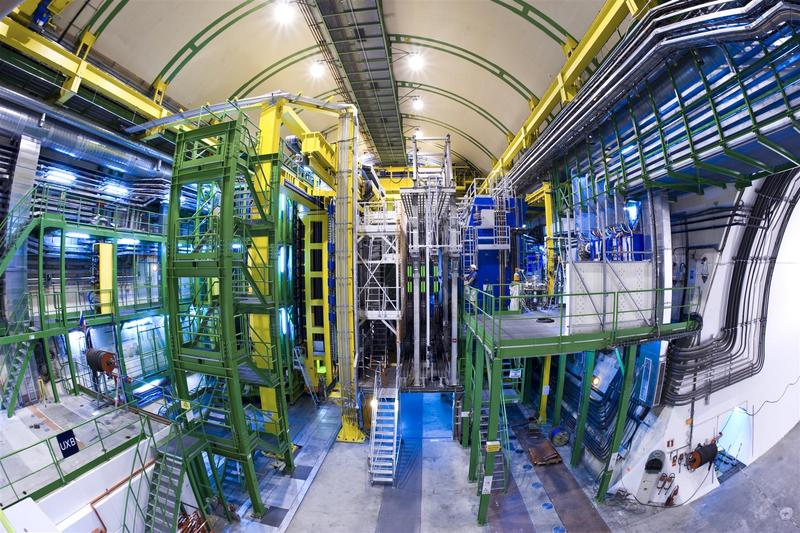
Researchers and Research professors
- Julien Cogan
- Renaud Le Gac
- Olivier Leroy (team responsible)
- Anton Poluektov
- Dorothea Vom Bruch
PHD students and post-doctoral fellows
Engineers and Technicians
- Andrew Morris
- Kevin Arnaud, electronic department
- Julien Langouët, electronic department
- Fredéric Hachon electronic department
- Costy Nassif electronic department
- Andreï Tsaregorodtsev, Detectors and Data department
Articles
2026: 27 articles
- First observation of violation and measurement of polarization in decays, R. Aaij et al., LHCb Collaboration, Phys. Rev. Lett 136 (2026) 021803
- Amplitude analysis of $B^0 _c(1S) K^+ ^- $ decays, R. Aaij et al., LHCb Collaboration, Eur. Phys. J. C 86 (2026) 537
- Measurement of the branching fraction of the decay and isospin asymmetry of decays, R. Aaij et al., LHCb Collaboration, J. High Energy Phys. 01 (2026) 159
- A model-independent measurement of the CKM angle in the decays and (), R. Aaij et al., LHCb Collaboration, J. High Energy Phys. 01 (2026) 062
- First evidence of violation in beauty baryon to charmonium decays, R. Aaij et al., LHCb Collaboration, Sci. Bull. 71 (2026) 547-557
- Observation of decays, R. Aaij et al., LHCb Collaboration, Phys. Rev. Lett 136 (2026) 021804
- Measurement of the cross-sections as a function of the muon transverse momentum in collisions at 5.02 TeV, R. Aaij et al., LHCb Collaboration, J. High Energy Phys. 03 (2026) 148
- Searches for and decays, R. Aaij et al., LHCb Collaboration, Phys. Rev. Lett 136 (2026) 181802
- Measurement of asymmetry in $D^0 \to K^0_{\rm S} K^0_{\rm S}$ decays with the LHCb Upgrade I detector, R. Aaij et al., LHCb Collaboration, J. High Energy Phys. 02 (2026) 253
- Search for decays at LHCb, R. Aaij et al., LHCb Collaboration, Phys. Rev. D 113 (2026) 072001
- Measurement of charged-hadron distributions in heavy-flavor jets in proton-proton collisions at =13 TeV, R. Aaij et al., LHCb Collaboration, J. High Energy Phys. 04 (2026) 029
- Minimising Event Size, Maximising Physics: Inclusive Particle Isolation for LHCb’s Run 3, M. Calvi et al., indéfini, Eur. Phys. J. C 86 (2026) 241
- Branching fraction measurement of the $\mathitΛ \to p μ^- \overlineν_μ$ decay, R. Aaij et al., LHCb Collaboration, J. High Energy Phys. 04 (2026) 096
- Differential decay rate of with the LHCb Upgrade I experiment, R. Aaij et al., LHCb Collaboration, J. High Energy Phys. 04 (2026) 170
- Observation and investigation of the structure in decays, R. Aaij et al., LHCb Collaboration, Phys. Rev. D 113 (2026) L071101
- First observation of the $\overline{B}_{s}^{0}\toΛ_{c}^{+}\overlineΛ_{c}{}^{-}$ decay and evidence for the $\overline{B}^{0}\toΛ_{c}^{+}\overlineΛ_{c}{}^{-}$ decay, R. Aaij et al., LHCb Collaboration, Phys. Rev. Lett 136 (2026) 061802
- Observation of the rare baryonic decay $B^{+}\rightarrow p \bar{\itΛ}$ and measurement of its weak decay parameter, R. Aaij et al., LHCb Collaboration, Phys. Rev. Lett 136 (2026) 051802
- Measurement of the branching fractions and longitudinal polarisations of $B^0_{(s)} \to K^{*0} \kern 0.18em \overline{\kern -0.18em K}{}^{*0}$ decays, R. Aaij et al., LHCb Collaboration, Phys. Rev. D 113 (2026) 092002
- Precision measurement of CP violation and branching fractions in decays and search for the rare decay , R. Aaij et al., LHCb Collaboration, Phys. Rev. Lett 136 (2026) 161801
- Measurement of the top-quark production cross-section and charge asymmetry at LHCb, R. Aaij et al., LHCb Collaboration, Phys. Rev. Lett 136 (2026) 221801
- Search for heavy neutral leptons in B-meson decays, R. Aaij et al., LHCb Collaboration, J. High Energy Phys. 03 (2026) 178
- A comprehensive analysis of the decay, R. Aaij et al., LHCb Collaboration, Phys. Rev. Lett 137 (2026) 021802
- Observation of the decay $χ_{c1}(3872)\rightarrow J\mskip -3mu/\mskip -2muψμ^+μ^-$, R. Aaij et al., LHCb Collaboration, Phys. Rev. D 113 (2026) 072019
- Observation of the doubly charmed baryon $\itΞ_{cc}^+$ with the LHCb Run 3 detector, R. Aaij et al., LHCb Collaboration, Phys. Rev. Lett 137 (2026) 021902
- Performance of the LHCb muon detector in Run 3, P. Albicocco et al., indéfini, Nucl. Instrum. Meth. A 1089 (2026) 171588
- Angular analysis of the $B^+\toπ^+μ^+μ^-$ decay, R. Aaij et al., LHCb Collaboration, J. High Energy Phys. 08 (2026) 004
- Observation of the charmless purely baryonic decay $\mathinner{\mathitΛ^0_b\!\to \mathitΛ p \overline{p}}$, R. Aaij et al., LHCb Collaboration, J. High Energy Phys. 08 (2026) 040
2025: 64 articles
- Long-lived particle reconstruction downstream of the LHCb magnet, R. Aaij et al., LHCb Collaboration, Eur. Phys. J. C 85 (2025) 7
- Measurement of the branching fraction ratios and using muonic decays, R. Aaij et al., LHCb Collaboration, Phys. Rev. Lett 134 (2025) 061801
- Amplitude analysis of decays, R. Aaij et al., indéfini, J. High Energy Phys. 01 (2025) 054
- Observation of exotic resonances in diffractive processes in proton-proton collisions, R. Aaij et al., LHCb Collaboration, Phys. Rev. Lett 134 (2025) 031902
- Measurement of mixing and search for violation with decays, R. Aaij et al., LHCb Collaboration, Phys. Rev. D 111 (2025) 012001
- Measurement of exclusive and production at TeV, R. Aaij et al., LHCb Collaboration, SciPost Phys. 18 (2025) 071
- Measurement of violation in and decays, R. Aaij et al., LHCb Collaboration, J. High Energy Phys. 01 (2025) 061
- First determination of the spin-parity of baryons, R. Aaij et al., LHCb Collaboration, Phys. Rev. Lett 134 (2025) 8
- Measurement of exclusive and production at TeV, R. Aaij et al., LHCb Collaboration, SciPost Phys. 18 (2025) 071
- Search for in decays, R. Aaij et al., LHCb Collaboration, Eur. Phys. J. C 85 (2025) 20
- Test of lepton flavour universality with decays, R. Aaij et al., LHCb Collaboration, Phys. Rev. Lett 134 (2025) 121803
- Measurements of and production within fully reconstructed jets, R. Aaij et al., LHCb Collaboration, Eur. Phys. J. C 85 (2025) 562
- Measurement of the CKM angle in decays, R. Aaij et al., LHCb Collaboration, J. High Energy Phys. 02 (2025) 113
- Study of in decays, R. Aaij et al., LHCb Collaboration, Sci. Bull. 70 (2025) 1432-1444
- Measurement of the to cross-section ratio as a function of centrality in PbPb collisions at = 5.02 TeV, R. Aaij et al., LHCb Collaboration, J. High Energy Phys. 07 (2025) 235
- Constraints on the photon polarisation in transitions using decays, R. Aaij et al., LHCb Collaboration, J. High Energy Phys. 03 (2025) 047
- First evidence for direct CP violation in beauty to charmonium decays, R. Aaij et al., LHCb Collaboration, Phys. Rev. Lett 134 (2025) 101801
- Measurement of meson production in fixed-target Ne collisions at = 68.5 GeV, R. Aaij et al., LHCb Collaboration, J. High Energy Phys. 03 (2025) 151
- Study of and decays to and evidence for violation in decays, R. Aaij et al., LHCb Collaboration, Phys. Rev. Lett 134 (2025) 101802
- Observation of the open-charm tetraquark state in the decay, R. Aaij et al., LHCb Collaboration, Phys. Rev. Lett 134 (2025) 101901
- Search for meson decays to and final states, R. Aaij et al., LHCb Collaboration, Phys. Rev. D 111 (2025) L091101
- Test of lepton flavour universality with decays, R. Aaij et al., LHCb Collaboration, Phys. Rev. Lett 134 (2025) 181803
- Measurement of asymmetries in decays, R. Aaij et al., LHCb Collaboration, Phys. Rev. D 111 (2025) 092004
- Study of light-meson resonances decaying to in the channels, R. Aaij et al., LHCb Collaboration, Phys. Rev. D 111 (2025) 092009
- Search for charge-parity violation in semileptonically tagged decays, R. Aaij et al., LHCb Collaboration, J. High Energy Phys. 03 (2025) 149
- Measurement of the multiplicity dependence of production ratios in collisions at TeV, R. Aaij et al., LHCb Collaboration, J. High Energy Phys. 05 (2025) 011
- Observation of the and decays, R. Aaij et al., LHCb Collaboration, Eur. Phys. J. C 85 (2025) 812
- Evidence for decays, R. Aaij et al., LHCb Collaboration, Phys. Rev. Lett 135 (2025) 021802
- Search for resonance-enhanced and angular asymmetries in the decay at LHCb, R. Aaij et al., LHCb Collaboration, Phys. Rev. D 111 (2025) L091102
- Angular analysis of decays, R. Aaij et al., LHCb Collaboration, J. High Energy Phys. 06 (2025) 140
- Observation of a new charmed baryon decaying to , R. Aaij et al., LHCb Collaboration, Phys. Rev. Lett 135 (2025) 161901
- Branching fraction measurement of the decay , R. Aaij et al., LHCb Collaboration, Phys. Rev. D 111 (2025) 092008
- Observation of charge-parity symmetry breaking in baryon decays, R. Aaij et al., LHCb Collaboration, Nature 643 (2025) 1223-1228
- Search for the decay, R. Aaij et al., LHCb Collaboration, J. High Energy Phys. 06 (2025) 013
- Observation of the very rare decay, R. Aaij et al., LHCb Collaboration, Phys. Rev. Lett 135 (2025) 051801
- Angular analysis of the decay , R. Aaij et al., LHCb Collaboration, J. High Energy Phys. 07 (2025) 069
- Observation of the doubly-charmed-baryon decay ${\it \Xi}_{cc}^{++}\to{\it \Xi}_{c}^{0}\pi^{+}\pi^{+}$, R. Aaij et al., LHCb Collaboration, J. High Energy Phys. 10 (2025) 136
- Observation of the decay and measurement of the branching fractions, R. Aaij et al., LHCb Collaboration, J. High Energy Phys. 07 (2025) 121
- Measurement of the branching fraction ratio at large dilepton invariant mass, R. Aaij et al., LHCb Collaboration, J. High Energy Phys. 07 (2025) 198
- Rapidity and multiplicity dependence of charged-particle flow in Pb collisions at TeV, R. Aaij et al., LHCb Collaboration, J. High Energy Phys. 10 (2025) 124
- First measurement of -jet mass with and without grooming, R. Aaij et al., LHCb Collaboration, Phys. Lett. B 869 (2025) 139854
- Measurements of charmed meson and antimeson production asymmetries at TeV, R. Aaij et al., LHCb Collaboration, J. High Energy Phys. 10 (2025) 050
- Measurement of the Z-boson mass, R. Aaij et al., LHCb Collaboration, Phys. Rev. Lett 135 (2025) 161802
- Measurement of the Lund plane for light- and beauty-quark jets, R. Aaij et al., LHCb Collaboration, Phys. Rev. D 112 (2025) 072015
- Three-pion Bose-Einstein correlations measured in proton-proton collisions, R. Aaij et al., LHCb Collaboration, J. High Energy Phys. 08 (2025) 174
- Coherent photoproduction of and excited vector mesons in ultraperipheral PbPb collisions, R. Aaij et al., LHCb Collaboration, J. High Energy Phys. 11 (2025) 103
- Measurement of to cross-section ratio as function of multiplicity in Pb collisions at TeV, R. Aaij et al., LHCb Collaboration, J. High Energy Phys. 11 (2025) 169
- Measurement of the and baryon lifetimes using hadronic -baryon decays, R. Aaij et al., LHCb Collaboration, J. High Energy Phys. 09 (2025) 157
- Search for the lepton-flavour-violating decays , R. Aaij et al., LHCb Collaboration, J. High Energy Phys. 11 (2025) 172
- Updated measurement of violation and polarisation in $B^0_s \rightarrow J/ψ\overline{K}{}^{*}\kern-1pt(892)^{0}$ decays, R. Aaij et al., LHCb Collaboration, J. High Energy Phys. 10 (2025) 173
- Study of states in the mass spectrum, R. Aaij et al., LHCb Collaboration, Phys. Rev. D 112 (2025) 112003
- Observation of orbitally excited states, R. Aaij et al., LHCb Collaboration, Phys. Rev. Lett 135 (2025) 231902
- Measurement of transverse and $\barΛ$ hyperon polarization in Pb collisions at TeV, R. Aaij et al., LHCb Collaboration, Phys. Rev. D 112 (2025) 112022
- First observation of the $\mathitΛ_b^{0}\!\rightarrow\mathitΛ_{c}^{+}D_{s}^{-}K^{+}K^{-}$ decay and search for pentaquarks in the $\mathitΛ_{c}^{+}D_{s}^{-}$ system, R. Aaij et al., LHCb Collaboration, Phys. Rev. D 112 (2025) 052013
- Precision measurement of the ${\itΞ}_b^0$ baryon lifetime, R. Aaij et al., LHCb Collaboration, Phys. Rev. D 112 (2025) 052012
- Improved measurement of mixing in decays, R. Aaij et al., LHCb Collaboration, J. High Energy Phys. 10 (2025) 113
- Measurement of the branching fraction, R. Aaij et al., LHCb Collaboration, J. High Energy Phys. 12 (2025) 151
- Search for the decay , R. Aaij et al., LHCb Collaboration, J. High Energy Phys. 12 (2025) 026
- Amplitude analysis of the decay and baryon polarization measurement in semileptonic beauty-hadron decays, R. Aaij et al., LHCb Collaboration, Phys. Rev. D 112 (2025) 092003
- Deuteron identification via time of flight with LHCb, R. Aaij et al., LHCb Collaboration, Eur. Phys. J. C 85 (2025) 1329
- First observation of the charmless baryonic decay $B^+\to\barΛp\bar{p}p$, R. Aaij et al., LHCb Collaboration, Phys. Rev. Lett 135 (2025) 261901
- Measurement of branching fractions and asymmetries in $\mathitΛ_b^0(\mathitΞ_b^0)\!\to pK_{\mathrm S}^0h^-$ decays, R. Aaij et al., LHCb Collaboration, J. High Energy Phys. 10 (2025) 169
- Inclusive -meson flavour-tagging algorithm at LHCb, R. Aaij et al., LHCb Collaboration, J. High Energy Phys. 11 (2025) 041
- Study of charm mixing and CP violation with $D^0\to K^\pmπ^\mpπ^\pmπ^\mp$ decays, R. Aaij et al., LHCb Collaboration, J. High Energy Phys. 12 (2025) 153
2024: 64 articles
- Measurement of production in Pb collisions at TeV at LHCb, R. Aaij et al., LHCb Collaboration, Phys. Rev. C 109 (2024) 044901
- The LHCb upgrade I, R. Aaij et al., LHCb Collaboration, J. Instrum 19 (2024) P05065
- Improved measurement of violation parameters in decays in the vicinity of the resonance, R. Aaij et al., LHCb Collaboration, Phys. Rev. Lett 132 (2024) 051802
- A search for rare decays, R. Aaij et al., LHCb Collaboration, J. High Energy Phys. 02 (2024) 032
- Observation of Cabibbo-suppressed two-body hadronic decays and precision mass measurement of the baryon, R. Aaij et al., LHCb Collaboration, Phys. Rev. Lett 132 (2024) 081802
- Measurement of the Z boson production cross-section in pp collisions at $ $ = 5.02 TeV, R. Aaij et al., LHCb Collaboration, J. High Energy Phys. 02 (2024) 070
- Measurement of the CKM angle $$ in the channel using self-conjugate decays, R. Aaij et al., LHCb Collaboration, Eur. Phys. J. C 84 (2024) 206
- Measurement of CP violation in decays, R. Aaij et al., LHCb Collaboration, Phys. Rev. Lett 132 (2024) 021801
- Measurement of prompt and production in pPb collisions at = 5.02 TeV, R. Aaij et al., LHCb Collaboration, J. High Energy Phys. 01 (2024) 070
- Helium identification with LHCb, R. Aaij et al., LHCb Collaboration, J. Instrum 19 (2024) P02010
- Enhanced production of baryons in high-multiplicity collisions at TeV, R. Aaij et al., LHCb Collaboration, Phys. Rev. Lett 132 (2024) 081901
- A measurement of , R. Aaij et al., LHCb Collaboration, J. High Energy Phys. 05 (2024) 253
- Observation of and decays, R. Aaij et al., LHCb Collaboration, Eur. Phys. J. C 84 (2024) 237
- Production of and mesons in and collisions, R. Aaij et al., LHCb Collaboration, Phys. Rev. C 109 (2024) 024907
- Search for violation in the phase space of $D^{0} K_{S}^{0} K^{} ^{} $ decays with the energy test, R. Aaij et al., LHCb Collaboration, J. High Energy Phys. 03 (2024) 107
- Search for violation in the phase space of $D^{0} K_{S}^{0} K^{} ^{} $ decays with the energy test, R. Aaij et al., LHCb Collaboration, J. High Energy Phys. 2403 (2024) 107
- Fraction of decays in prompt production measured in pPb collisions at TeV, R. Aaij et al., LHCb Collaboration, Phys. Rev. Lett 132 (2024) 102302
- Fraction of decays in prompt production measured in collisions at , R. Aaij et al., LHCb Collaboration, Phys. Rev. Lett 132 (2024) 102302
- Charge-dependent curvature-bias corrections using a pseudomass method, R. Aaij et al., LHCb Collaboration, J. Instrum 19 (2024) P03010
- Measurement of the longitudinal polarization in decays, R. Aaij et al., LHCb Collaboration, Phys. Rev. D 110 (2024) 092007
- A model-independent measurement of the CKM angle in partially reconstructed decays with (h = , K), R. Aaij et al., LHCb Collaboration, J. High Energy Phys. 02 (2024) 118
- Measurement of forward charged hadron flow harmonics in peripheral PbPb collisions at TeV with the LHCb detector, R. Aaij et al., LHCb Collaboration, Phys. Rev. C 109 (2024) 054908
- Observation of and decays, R. Aaij et al., LHCb Collaboration, Eur. Phys. J. C 84 (2024) 575
- Observation of and decays, R. Aaij et al., LHCb Collaboration, Eur. Phys. J. C 84 (2024) 575
- Measurement of associated - production cross-section in collisions at TeV, R. Aaij et al., LHCb Collaboration, J. High Energy Phys. 05 (2024) 259
- Measurement of -pair production in collisions at TeV and study of gluon transverse-momentum dependent PDFs, R. Aaij et al., LHCb Collaboration, J. High Energy Phys. 03 (2024) 088
- Momentum scale calibration of the LHCb spectrometer, R. Aaij et al., LHCb Collaboration, J. Instrum 19 (2024) P02008
- Determination of short- and long-distance contributions in decays, R. Aaij et al., LHCb Collaboration, Phys. Rev. D 109 (2024) 052009
- Amplitude analysis of the decay, R. Aaij et al., LHCb Collaboration, Phys. Rev. Lett 132 (2024) 131801
- Determination of short- and long-distance contributions in decays, R. Aaij et al., LHCb Collaboration, Phys. Rev. D 109 (2024) 052009
- Search for decays and measurement of the branching fraction ratio ${\cal B}(B_c^+\to\psi(2S)\pi^+)/{\cal B}(B_c^+\to J/\psi \pi^+)$, R. Aaij et al., LHCb Collaboration, Eur. Phys. J. C 84 (2024) 468
- Study of $B_c^+ _c^+ $ decays, R. Aaij et al., LHCb Collaboration, J. High Energy Phys. 02 (2024) 173
- Multiplicity dependence of in collisions at TeV, R. Aaij et al., LHCb Collaboration, J. High Energy Phys. 05 (2024) 243
- Prompt and nonprompt production in Pb collisions at TeV, R. Aaij et al., LHCb Collaboration, J. High Energy Phys. 04 (2024) 111
- Visualisation of -violation effects in decay-time-dependent analyses of multibody -meson decays, T. Gershon et al., LHCb Collaboration, Eur. Phys. J. C 84 (2024) 327
- Study of violation in decays with , $ ( )$, and final states, R. Aaij et al., LHCb Collaboration, J. High Energy Phys. 05 (2024) 025
- Measurements of the branching fraction ratio $\cal{B}(\phi \to \mu^+\mu^-)/\cal{B}(\phi \to e^+e^-)$ with charm meson decays, R. Aaij et al., LHCb Collaboration, J. High Energy Phys. 05 (2024) 293
- Measurement of the Branching Fraction of Decays, R. Aaij et al., LHCb Collaboration, J. High Energy Phys. 05 (2024) 065
- Modification of (3872) and (2) production in Pb collisions at TeV, R. Aaij et al., LHCb Collaboration, Phys. Rev. Lett 132 (2024)
- Observation of the decay, R. Aaij et al., LHCb Collaboration, J. High Energy Phys. 04 (2024) 151
- First observation of the decay, R. Aaij et al., LHCb Collaboration, J. High Energy Phys. 07 (2024) 140
- Amplitude analysis of the decay, R. Aaij et al., LHCb Collaboration, J. High Energy Phys. 06 (2024) 098
- Tracking of charged particles with nanosecond lifetimes at LHCb, R. Aaij et al., LHCb Collaboration, Eur. Phys. J. C 84 (2024) 761
- Search for the decay, R. Aaij et al., LHCb Collaboration, J. High Energy Phys. 07 (2024) 101
- Search for prompt production of pentaquarks in charm hadron final states, R. Aaij et al., LHCb Collaboration, Phys. Rev. D 110 (2024) 032001
- Amplitude analysis and branching fraction measurement of decays, R. Aaij et al., LHCb Collaboration, J. High Energy Phys. 08 (2024) 165
- First observation of decays, R. Aaij et al., LHCb Collaboration, Phys. Rev. D 110 (2024) L031104
- Search for time-dependent violation in decays, R. Aaij et al., LHCb Collaboration, Phys. Rev. Lett 133 (2024) 101803
- Transverse polarization measurement of hyperons in Ne collisions at = 68.4 GeV with the LHCb detector, R. Aaij et al., LHCb Collaboration, J. High Energy Phys. 09 (2024) 082
- Search for the lepton-flavor violating decay , R. Aaij et al., LHCb Collaboration, Phys. Rev. D 110 (2024) 072014
- Study of -hadron decays to final states, R. Aaij et al., LHCb Collaboration, J. High Energy Phys. 08 (2024) 132
- Comprehensive analysis of local and nonlocal amplitudes in the decay, R. Aaij et al., LHCb Collaboration, J. High Energy Phys. 09 (2024) 026
- Amplitude analysis of the radiative decay , R. Aaij et al., LHCb Collaboration, J. High Energy Phys. 08 (2024) 093
- Observation of new charmonium(-like) states in decays, R. Aaij et al., LHCb Collaboration, Phys. Rev. Lett 133 (2024) 131902
- Precision measurement of the baryon lifetime, R. Aaij et al., LHCb Collaboration, Phys. Rev. D 110 (2024) 072002
- Probing the nature of the state using radiative decays, R. Aaij et al., LHCb Collaboration, J. High Energy Phys. 11 (2024) 121
- Search for the rare decay, R. Aaij et al., LHCb Collaboration, Phys. Rev. D 110 (2024) 052007
- Study of charmonium production via the decay to at $\sqrt{s} = 13\,\rm{TeV}$, R. Aaij et al., LHCb Collaboration, Eur. Phys. J. C 84 (2024) 1274
- Observation of muonic Dalitz decays of mesons and precise spectroscopy of hidden-beauty states, R. Aaij et al., LHCb Collaboration, J. High Energy Phys. 10 (2024) 122
- Study of the rare decay $J\mskip -3mu/\mskip -2mu\psi \to \mu^+\mu^-\mu^+\mu^-$, R. Aaij et al., LHCb Collaboration, J. High Energy Phys. 12 (2024) 062
- Measurement of , and decay parameters using decays, R. Aaij et al., LHCb Collaboration, Phys. Rev. Lett 133 (2024) 261804
- Measurement of violation observables in decays, R. Aaij et al., LHCb Collaboration, Phys. Rev. Lett 133 (2024) 251801
- Analysis of decays, R. Aaij et al., LHCb Collaboration, J. High Energy Phys. 12 (2024) 147
- Measurement of the effective leptonic weak mixing angle, R. Aaij et al., LHCb Collaboration, J. High Energy Phys. 26 (2024)
Conference proceedings
2026: 3 conference proceedings
- Angular analyses of rare b-hadron decays at LHCb, B. Kutsenko, indéfini, 2025,13th Large Hadron Collider Physics Conference (2026) 057, Taipei, Taiwan, 5-9 May 2025
- Rare and radiative decays at LHCb, T. Fulghesu, PoS, 2025,13th Large Hadron Collider Physics Conference (2026) 056, Taipei, Taiwan, 5-9 May 2025
- PCIe400 generic readout board qualification test, K. Arnaud, A. Back, D. Charlet, G. Degret, L. Del Buono, P. Durante, A. Hervo, F. Hachon, X. Lafay, J. Langouët, R. Le Gac, J.-L. Meunier, J.-M. Nappa, C. N. Mattar, C. Renard, G. Vouters, indéfini, ,Topical Workshop on Electronics for Particle Physics (2026) , Rethymno, Greece, 6-10 Oct 2025
2025: 6 conference proceedings
- Lepton Flavour Universality Tests Using Semileptonic b-Hadron Decays at the LHCb Detector, B. Kutsenko, Particles, 8,13th International Conference on New Frontiers in Physics (2025) 5, Kolymbari, Greece, 26 Sep - 04 Oct 2024
- CHEP 2024: Preface to the Proceedings, A. Dziurda, T. Szumlak, K. V. Ellis, S. Hageboeck, M. Schulz, D. v. Bruch, EPJ Web Conf., 337,27th International Conference on Computing in High Energy and Nuclear Physics (2025) 00001, Krakow, Poland, 21-25 Oct 2024
- A Low-Cost, Low-Power Media Converter Solution for Next-Generation Detector Readout Systems, Perro, Alberto, Vodnik, Mitja, Durante, Paolo, J. Instrum, 20,Topical Workshop on Electronics for Particle Physics (2025) C02027, Glasgow, United Kingdom, 30 Sep - 04 Oct 2024
- Technical challenges designing a prototype common readout board for LHCb future upgrades, J. J. Langouët, J.-P. Cachemiche, P. Bibron, J. Instrum, 20,Topical Workshop on Electronics for Particle Physics (2025) C03006, Glasgow, United Kingdom, 30 Sep - 04 Oct 2024
- Unveiling the shape of the Ne nucleus by measuring the flow coefficients with cumulants in PbNe and PbAr collisions at GeV, R. Aaij, A. S. W. Abdelmotteleb, C. Abellan Beteta, F. J. Abudinén, T. Ackernley, A. M. Adefisoye, B. Adeva, M. Adinolfi, P. H. Adlarson, C. Agapopoulou, C. A. Aidala, Z. Ajaltouni, S. Akar, K. Akiba, M. Akthar, P. Albicocco, J. Albrecht, R. Aleksiejunas, F. Alessio, P. Alvarez Cartelle, R. Amalric, S. Amato, J. L. Amey, Y. Amhis, L. An, L. Anderlini, M. Andersson, P. Andreola, M. Andreotti, S. Andres Estrada, A. Anelli, D. Ao, C. Arata, F. Archilli, Z. Areg, M. Argenton, S. Arguedas Cuendis, L. Arnone, A. Artamonov, M. Artuso, E. Aslanides, R. Ataíde Da Silva, M. Atzeni, B. Audurier, J. Authier, D. Bacher, I. Bachiller Perea, S. Bachmann, M. Bachmayer, J. Back, P. Baladron Rodriguez, V. Balagura, A. Balboni, W. Baldini, Z. Baldwin, L. Balzani, H. Bao, J. Baptista de Souza Leite, C. J. Barbero Pretel, M. Barbetti, I. R. Barbosa, R. Barlow, M. Barnyakov, S. Barsuk, W. Barter, J. Bartz, S. Bashir, B. Batsukh, P. Battista, A. Bay, A. Beck, M. Becker, F. Bedeschi, I. Bediaga, N. A. Behling, S. Belin, A. Bellavista, K. Belous, I. Belov, I. Belyaev, G. Benane, G. Bencivenni, E. Ben-Haim, A. Berezhnoy, R. Bernet, S. Bernet Andres, A. Bertolin, F. Betti, J. Bex, O. Bezshyyko, S. Bhattacharya, J. Bhom, M. S. Bieker, N. V. Biesuz, A. Biolchini, M. Birch, F. C. R. Bishop, A. Bitadze, A. Bizzeti, T. Blake, F. Blanc, J. E. Blank, S. Blusk, V. Bocharnikov, J. A. Boelhauve, O. Boente Garcia, T. Boettcher, A. Bohare, A. Boldyrev, C. Bolognani, R. Bolzonella, R. Bonacci, N. Bondar, A. Bordelius, F. Borgato, S. Borghi, M. Borsato, J. T. Borsuk, E. Bottalico, S. A. Bouchiba, M. Bovill, T. Bowcock, A. Boyer, C. Bozzi, J. D. Brandenburg, A. Brea Rodriguez, N. Breer, J. Brodzicka, J. D. Brown, D. Brundu, E. Buchanan, M. Burgos Marcos, A. T. Burke, C. Burr, C. Buti, J. S. Butter, J. Buytaert, W. Byczynski, S. Cadeddu, H. Cai, Y. Cai, A. Caillet, R. Calabrese, S. Calderon Ramirez, L. Calefice, M. Calvi, M. Calvo Gomez, P. Camargo Magalhaes, J. I. Cambon Bouzas, P. Campana, A. F. Campoverde Quezada, S. Capelli, M. Caporale, L. Capriotti, R. G. Caravaca-Mora, A. Carbone, L. Carcedo Salgado, R. Cardinale, A. Cardini, P. Carniti, L. D. Carus, A. Casais Vidal, R. Caspary, G. Casse, M. Cattaneo, G. Cavallero, V. Cavallini, S. Celani, I. Celestino, S. Cesare, A. J. Chadwick, I. Chahrour, H. Chang, M. Charles, P. Charpentier, E. Chatzianagnostou, R. Cheaib, M. Chefdeville, C. Chen, J.-A. Chen, S. Chen, Z. Chen, A. Chen Hu, M. Cherif, A. Chernov, S. Chernyshenko, X. Chiotopoulos, V. Chobanova, M. Chrzaszcz, A. Chubykin, V. Chulikov, P. Ciambrone, X. Cid Vidal, G. Ciezarek, P. Cifra, P. Clarke, M. Clemencic, H. Cliff, J. Closier, C. E. Cocha Toapaxi, V. Coco, J. Cogan, E. Cogneras, L. Cojocariu, S. E. Collaviti, P. Collins, T. Colombo, M. Colonna, A. Comerma-Montells, L. Congedo, J. Connaughton, A. Contu, N. Cooke, G. Cordova, C. A. Coronel, I. Corredoira, A. Correia, G. Corti, J. Cottee Meldrum, B. Couturier, D. C. Craik, M. M. Cruz Torres, E. Curras Rivera, R. Currie, C. L. Da Silva, S. Dadabaev, X. Dai, E. Dall’Occo, J. Dalseno, C. D’Ambrosio, J. Daniel, G. Darze, A. Davidson, J. E. Davies, O. De Aguiar Francisco, C. De Angelis, F. De Benedetti, J. de Boer, K. De Bruyn, S. De Capua, M. De Cian, U. De Freitas Carneiro Da Graca, E. De Lucia, J. De Miranda, L. De Paula, M. De Serio, P. De Simone, F. De Vellis, J. de Vries, F. Debernardis, D. Decamp, S. M. Dekkers, L. Del Buono, B. Delaney, H. P. Dembinski, J. Deng, V. Denysenko, O. Deschamps, F. Dettori, B. Dey, P. Di Nezza, I. Diachkov, S. Didenko, S. Ding, Y. Ding, L. Dittmann, V. Dobishuk, A. Docheva, A. P. Doheny, C. Dong, A. M. Donohoe, F. Dordei, A. dos Reis, A. J. Dowling, L. M. S. Dreyfus, W. Duan, P. J. Duda, L. Dufour, V. Duk, P. Durante, M. Duras, J. M. Durham, O. Durmus, A. Dziurda, A. Dzyuba, S. Easo, E. Eckstein, U. Egede, A. Egorychev, V. Egorychev, S. Eisenhardt, E. Ejopu, L. Eklund, M. Elashri, D. G. Elizondo Blanco, J. H. Ellbracht, S. Ely, A. Ene, J. N. Eschle, S. Esen, T. Evans, F. Fabiano, S. Faghih, L. Falcao, B. Fang, R. Fantechi, L. Fantini, M. Faria, K. G. Farmer, F. P. J. Fassin, D. Fazzini, L. J. Felkowski, M. Feng, A. Fernandez Casani, M. Fernandez Gomez, A. D. Fernez, F. Ferrari, F. Ferreira Rodrigues, M. Ferrillo, M. Ferro-Luzzi, S. Filippov, R. A. Fini, M. Fiorini, M. Firlej, K. L. Fischer, D. S. Fitzgerald, C. Fitzpatrick, T. Fiutowski, F. Fleuret, A. Fomin, M. Fontana, L. A. Foreman, R. Forty, D. Foulds-Holt, V. Franco Lima, M. Franco Sevilla, M. Frank, E. Franzoso, G. Frau, C. Frei, D. A. Friday, J. Fu, Q. Führing, T. Fulghesu, G. Galati, M. D. Galati, A. Gallas Torreira, D. Galli, S. Gambetta, M. Gandelman, P. Gandini, B. A. Ganie, H. Gao, R. Gao, T.-Q. Gao, Y. Gao, Y. Gao, Y. Gao, L. M. Garcia Martin, P. Garcia Moreno, J. García Pardiñas, P. T. Gardner, L. Garrido, C. Gaspar, A. Gavrikov, L. L. Gerken, E. Gersabeck, M. Gersabeck, T. Gershon, S. Ghizzo, Z. Ghorbanimoghaddam, F. I. Giasemis, V. Gibson, H. K. Giemza, A. L. Gilman, M. Giovannetti, A. Gioventù, L. G. Girardey, M. A. Giza, F. C. Glaser, V. Gligorov, C. Göbel, L. Golinka-Bezshyyko, E. Golobardes, D. Golubkov, A. Golutvin, S. Gomez Fernandez, W. Gomulka, I. Gonçales Vaz, F. Goncalves Abrantes, M. Goncerz, G. Gong, J. A. Gooding, I. V. Gorelov, C. Gotti, E. Govorkova, J. P. Grabowski, L. A. Granado Cardoso, E. Graugés, E. Graverini, L. Grazette, G. Graziani, A. T. Grecu, N. A. Grieser, L. Grillo, S. Gromov, C. Gu, M. Guarise, L. Guerry, A.-K. Guseinov, E. Gushchin, Y. Guz, T. Gys, K. S. Habermann, T. Hadavizadeh, C. Hadjivasiliou, G. Haefeli, C. Haen, S. J. Haken, G. Hallett, P. M. Hamilton, J. Hammerich, Q. Han, X. Han, S. Hansmann-Menzemer, L. Hao, N. Harnew, T. J. Harris, M. Hartmann, S. Hashmi, J. He, N. B. Heatley, A.-I. Hedes, F. Hemmer, C. Henderson, R. Henderson, R. D. L. Henderson, A. M. Hennequin, K. Hennessy, L. Henry, J. D. Herd, P. Herrero Gascon, J. Heuel, A.-M. Heyn, A. Hicheur, G. Hijano Mendizabal, J. E. Horswill, R. Hou, Y. Hou, D. C. Houston, N. F. Howarth, W. Hu, X. Hu, W. Hulsbergen, R. J. Hunter, M. Hushchyn, D. Hutchcroft, M. Idzik, D. Ilin, P. Ilten, A. Iniukhin, A. Iohner, A. Ishteev, K. Ivshin, H. Jage, S. J. Jaimes Elles, S. Jakobsen, T. Jakoubek, E. Jans, B. K. Jashal, A. Jawahery, C. Jayaweera, V. Jevtic, Z. Jia, E. K. Jiang, X. Jiang, Y. Jiang, Y. Jiang, E. Jimenez Moya, N. Jindal, M. John, A. C. John Rubesh Rajan, D. Johnson, C. Jones, S. Joshi, B. Jost, J. J. Juan Castella, N. Jurik, I. Juszczak, K. K. Kalecinska, D. Kaminaris, S. Kandybei, M. J. Kane, Y. Kang, C. Kar, M. Karacson, A. Kauniskangas, J. W. Kautz, M. K. Kazanecki, F. Keizer, M. Kenzie, T. Ketel, B. Khanji, A. Kharisova, S. Kholodenko, G. Khreich, T. Kirn, V. S. Kirsebom, S. Klaver, N. Kleijne, A. Kleimenova, D. Klekots, K. Klimaszewski, M. R. Kmiec, T. K. Knospe, R. Kolb, S. Koliiev, L. Kolk, A. Konoplyannikov, P. Kopciewicz, P. Koppenburg, A. Korchin, M. Korolev, I. Kostiuk, O. Kot, S. Kotriakhova, E. M. Kowalczyk, A. Kozachuk, P. Kravchenko, L. Kravchuk, O. Kravcov, M. Kreps, P. Krokovny, W. Krupa, W. Krzemien, O. Kshyvanskyi, S. A. Kubis, M. Kucharczyk, V. Kudryavtsev, E. Kulikova, A. Kupsc, V. Kushnir, B. Kutsenko, J. Kvapil, I. Kyryllin, D. Lacarrere, P. Laguarta Gonzalez, A. Lai, A. Lampis, D. Lancierini, C. Landesa Gomez, J. J. Lane, G. Lanfranchi, C. Langenbruch, J. Langer, T. Latham, F. Lazzari, C. Lazzeroni, R. Le Gac, H. S. Lee, R. Lefèvre, A. Leflat, S. Legotin, M. Lehuraux, E. Lemos Cid, O. Leroy, T. Lesiak, E. D. Lesser, B. Leverington, A. Li, C. Li, C.-H. Li, H. Li, J. Li, K. Li, L. Li, M. Li, P. Li, P.-R. Li, Q. Li, T. Li, T. Li, Y. Li, Y. Li, Y. Li, Z. Lian, Q. Liang, X. Liang, Z. Liang, S. Libralon, A. Lightbody, C. Lin, T.-H. Lin, R. Lindner, H. J. Linton, R. Litvinov, D. Liu, F. X. Liu, G. Liu, K. Liu, S. Liu, W. Liu, Y. Liu, Y. Liu, Y. Liu, G. A. Loachamin Ordonez, I. G. Lobo, A. Lobo Salvia, A. Loi, T. Long, F. Cesario Laterza Lopes, J. Lopes, A. Lopez Huertas, C. Lopez Iribarnegaray, S. López Soliño, Q. Lu, C. Lucarelli, D. Lucchesi, M. Lucio Martinez, Y. Luo, A. Lupato, E. Luppi, K. Lynch, X.-R. Lyu, G. Ma, H. Ma, S. Maccolini, F. Machefert, F. Maciuc, B. Mack, I. Mackay, L. G. Mackey, L. R. Madhan Mohan, M. J. Madurai, D. Magdalinski, D. Maisuzenko, J. J. Malczewski, S. Malde, L. Malentacca, A. Malinin, T. Maltsev, G. Manca, G. Mancinelli, C. Mancuso, R. Manera Escalero, F. Manganella, D. Manuzzi, D. Marangotto, J. F. Marchand, R. Marchevski, U. Marconi, E. Mariani, S. Mariani, C. Marin Benito, J. Marks, A. M. Marshall, L. Martel, G. Martelli, G. Martellotti, L. Martinazzoli, M. Martinelli, D. G. Martinez Gomez, D. Martinez Santos, F. Martinez Vidal, A. I. Martorell Granollers, A. Massafferri, R. Matev, A. Mathad, V. Matiunin, C. Matteuzzi, K. R. Mattioli, A. Mauri, E. Maurice, J. Mauricio, P. P. L. Mayencourt, J. Mazorra de Cos, M. Mazurek, M. McCann, N. T. McHugh, A. McNab, R. McNulty, B. Meadows, G. Meier, D. Melnychuk, D. Mendoza Granada, P. E. Menendez Valdes Perez, F. Meng, M. Merk, A. Merli, L. Meyer Garcia, D. Miao, H. Miao, M. Mikhasenko, D. A. Milanes, A. Minotti, E. Minucci, T. Miralles, B. Mitreska, D. S. Mitzel, R. M. Mocanu, A. Modak, L. Moeser, R.-D. Moise, E. F. Molina Cardenas, T. Mombächer, M. D. Monk, T. A. Monnard, S. Monteil, A. Morcillo Gomez, G. Morello, M. J. Morello, M. P. Morgenthaler, A. Moro, J. Moron, W. Morren, A. B. Morris, A. G. Morris, R. Mountain, Z. Mu, E. Muhammad, F. Muheim, M. Mulder, K. Müller, F. Muñoz-Rojas, R. Murta, V. Mytrochenko, P. Naik, T. Nakada, R. Nandakumar, T. Nanut, G. Napoletano, I. Nasteva, M. Needham, E. Nekrasova, N. Neri, S. Neubert, N. Neufeld, P. Neustroev, J. Nicolini, D. Nicotra, E. M. Niel, N. Nikitin, L. Nisi, Q. Niu, P. Nogarolli, P. Nogga, C. Normand, J. Novoa Fernandez, G. M. Nowak, C. Nunez, H. H. Nur, A. Oblakowska-Mucha, V. Obraztsov, T. Oeser, A. Okhotnikov, O. Okhrimenko, R. Oldeman, F. Oliva, E. Olivart Pino, M. Olocco, R. H. O’Neil, J. S. Ordonez Soto, D. Osthues, J. M. Otalora Goicochea, P. Owen, M. A. Oyanguren, O. Ozcelik, F. Paciolla, A. Padee, K. O. Padeken, B. Pagare, T. Pajero, A. Palano, L. Palini, M. Palutan, C. Pan, X. Pan, S. Panebianco, S. Paniskaki, G. Panshin, L. Paolucci, A. Papanestis, M. Pappagallo, L. Pappalardo, C. Pappenheimer, C. Parkes, D. Parmar, G. Passaleva, D. Passaro, A. Pastore, M. Patel, J. T. Patoc, C. Patrignani, A. Paul, C. J. Pawley, A. Pellegrino, J. Peng, X. Peng, M. Pepe Altarelli, S. Perazzini, D. Pereima, H. Pereira Da Costa, M. Pereira Martinez, A. Pereiro Castro, C. U. Perez, P. Perret, A.-K. Perrevoort, A. Perro, M. J. Peters, K. Petridis, A. Petrolini, S. Pezzulo, J. Pfaller, H. Pham, L. Pica, M. Piccini, L. Piccolo, B. Pietrzyk, G. Pietrzyk, R. N. Pilato, D. Pinci, F. Pisani, M. Pizzichemi, V.-M. Placinta, M. Plo Casasus, T. Poeschl, F. Polci, M. Poli Lener, A. Poluektov, N. Polukhina, I. Polyakov, E. Polycarpo, S. Ponce, D. Popov, K. L. Popp, S. Poslavskii, K. Prasanth, C. Prouve, D. Provenzano, V. Pugatch, A. Puicercus Gomez, G. Punzi, J. R. Pybus, Q. Qian, W. Qian, N. Qin, R. Quagliani, R. I. Rabadan Trejo, R. Racz, J. Rademacker, M. Rama, M. Ramírez García, V. Ramos De Oliveira, M. Ramos Pernas, M. Rangel, F. Ratnikov, G. Raven, M. Rebollo De Miguel, F. Redi, J. Reich, F. Reiss, Z. Ren, P. K. Resmi, M. Ribalda Galvez, R. Ribatti, G. Ricart, D. Riccardi, S. Ricciardi, K. A. Richardson, M. Richardson-Slipper, F. Riehn, K. Rinnert, P. Robbe, G. Robertson, E. Rodrigues, A. Rodriguez Alvarez, E. X. Rodriguez Fernandez, J. A. Rodriguez Lopez, E. Rodriguez Rodriguez, J. M. Roensch, A. Rogachev, A. Rogovskiy, D. L. Rolf, P. Roloff, V. Romanovskiy, A. Romero Vidal, G. Romolini, F. Ronchetti, T. Rong, M. Rotondo, S. Roy, M. S. Rudolph, M. Ruiz Diaz, R. A. Ruiz Fernandez, J. Ruiz Vidal, J. J. Saavedra-Arias, J. J. Saborido Silva, M. Sacha Emile R., N. Sagidova, D. Sahoo, N. Sahoo, B. Saitta, M. Salomoni, I. Sanderswood, R. Santacesaria, C. Santamarina Rios, M. Santimaria, L. Santoro, E. Santovetti, A. Saputi, D. Saranin, A. Sarnatskiy, G. Sarpis, M. Sarpis, C. Satriano, A. Satta, M. Saur, D. Savrina, H. Sazak, F. Sborzacchi, A. Scarabotto, S. Schael, S. Scherl, M. Schiller, H. Schindler, M. Schmelling, B. Schmidt, N. Schmidt, S. Schmitt, H. Schmitz, O. Schneider, A. Schopper, N. Schulte, M. H. Schune, G. Schwering, B. Sciascia, A. Sciuccati, G. W. Scriven, I. Segal, S. Sellam, A. Semennikov, T. C. Senger, M. Senghi Soares, A. Sergi, N. Serra, L. Sestini, A. Seuthe, B. Sevilla Sanjuan, Y. Shang, D. M. Shangase, M. Shapkin, R. Sharma, I. Shchemerov, L. Shchutska, T. Shears, L. Shekhtman, Z. Shen, S. Sheng, V. Shevchenko, B. Shi, Q. Shi, W. Shi, Y. Shimizu, E. Shmanin, R. Shorkin, J. D. Shupperd, R. Silva Coutinho, G. Simi, S. Simone, M. Singha, N. Skidmore, T. Skwarnicki, M. Slater, E. Smith, K. L. Smith, M. Smith, L. Soares Lavra, M. Sokoloff, P. Soler, A. Solomin, A. Solovev, K. Solovieva, N. Sommerfeld, R. Song, Y. Song, Y. Song, Y. Song, F. L. Souza De Almeida, B. Souza De Paula, K. M. Sowa, E. Spadaro Norella, E. Spedicato, J. G. Speer, P. Spradlin, F. Stagni, M. Stahl, S. Stahl, S. Stanislaus, M. Z. Stefaniak, E. N. Stein, O. Steinkamp, D. Strekalina, Y. Su, F. Suljik, J. Sun, J. Sun, L. Sun, D. Sundfeld, W. Sutcliffe, P. Svihra, V. Svintozelskyi, K. Swientek, F. Swystun, A. Szabelski, T. Szumlak, Y. Tan, Y. Tang, Y. Tang, M. D. Tat, J. A. Teijeiro Jimenez, A. Terentev, F. Terzuoli, F. Teubert, E. Thomas, D. J. D. Thompson, A. R. Thomson-Strong, H. Tilquin, V. Tisserand, S. T’Jampens, M. Tobin, T. G. Todorov, L. Tomassetti, G. Tonani, X. Tong, T. Tork, D. Torres Machado, L. Toscano, D. Y. Tou, C. Trippl, G. Tuci, N. Tuning, L. H. Uecker, A. Ukleja, D. J. Unverzagt, A. Upadhyay, B. Urbach, A. Usachov, A. Ustyuzhanin, U. Uwer, V. Vagnoni, A. Vaitkevicius, V. Valcarce Cadenas, G. Valenti, N. Valls Canudas, J. van Eldik, H. Van Hecke, E. van Herwijnen, C. B. Van Hulse, R. Van Laak, M. van Veghel, G. Vasquez, R. Vazquez Gomez, P. Vazquez Regueiro, C. Vázquez Sierra, S. Vecchi, J. Velilla Serna, J. Velthuis, M. Veltri, A. Venkateswaran, M. Verdoglia, M. Vesterinen, W. Vetens, D. Vico Benet, P. Vidrier Villalba, M. Vieites Diaz, X. Vilasis-Cardona, E. Vilella Figueras, A. Villa, P. Vincent, B. Vivacqua, F. C. Volle, D. vom Bruch, N. Voropaev, K. Vos, C. Vrahas, J. P. Wagner, J. Walsh, E. J. Walton, G. Wan, A. Wang, B. Wang, C. Wang, G. Wang, H.-J. Wang, J. Wang, J. Wang, J. Wang, J. Wang, M. Wang, N. Wang, R. Wang, X. Wang, X. Wang, X. Wang, Y. Wang, Y. Wang, Y. Wang, Z. Wang, Z. Wang, J. A. Ward, M. Waterlaat, N. Watson, D. Websdale, Y. Wei, Z. Weida, J. Wendel, B. D. C. Westhenry, C. J. White, M. Whitehead, E. Whiter, A. R. Wiederhold, D. Wiedner, M. Wiegertjes, C. Wild, G. Wilkinson, M. K. Wilkinson, M. Williams, M. J. Williams, M. R. J. Williams, R. M. Williams, S. J. Williams, Z. Williams, F. Wilson, M. A. Winn, W. Wislicki, M. Witek, L. Witola, T. Wolf, E. Wood, G. Wormser, S. Wotton, H. Wu, J. Wu, X. Wu, Y. Wu, Z. Wu, K. Wyllie, S. Xian, Z. Xiang, Y. Xie, T. Xing, A. Xu, L. Xu, M. Xu, Z. Xu, Z. Xu, Z. Xu, S. Yadav, K. Yang, X. Yang, Y. Yang, Y. Yang, Z. Yang, V. Yeroshenko, H. Y. D. Yeung, H. Yin, X. Yin, C. Yu, J. Yu, X. Yuan, Y. Yuan, J. A. Zamora Saa, M. Zavertyaev, M. Zdybal, F. Zenesini, C. Zeng, M. Zeng, C. Zhang, D. Zhang, J. Zhang, L. Zhang, R. Zhang, S. Zhang, S. Zhang, Y. Zhang, Y. Zhang, Z. Zhang, Y. Zhao, A. Zhelezov, S. Zheng, X. Zheng, Y. Zheng, T. Zhou, X. Zhou, Y. Zhou, V. Zhovkovska, L. Zhu, X. Zhu, X. Zhu, Y. Zhu, V. Zhukov, J. Zhuo, Q. Zou, D. Zuliani, G. Zunica, indéfini, ,8th International Conference on the Initial Stages of High-Energy Nuclear Collisions (2025) , Taipei, Taiwan, 7-12 Sep 2025
- Evaluating FPGA Acceleration with Intel ® oneAPI Toolkit for High-Speed Data Processing, Perro, Alberto, Durante, Paolo, Pisani, Flavio, Xochelli, Eleni, EPJ Web Conf., 337,27th International Conference on Computing in High Energy and Nuclear Physics (2025) 01070, Krakow, Poland, 21-25 Oct 2024
2024: 4 conference proceedings
- LHCb measurements on semileptonic decays of -hadrons, C. Chen, PoS, EPS-HEP2023,2023 European Physical Society Conference on High Energy Physics (2024) 338, Hamburg, Germany, 21-25 Aug 2023
- LHCb measurements on semileptonic decays of -hadrons, C. Chen, PoS, EPS-HEP2023,2023 European Physical Society Conference on High Energy Physics (2024) 338, Hamburg, Germany, 21-25 Aug 2023
- Combined angular analysis of B → D∗eνe and B → D∗μνμ at the LHCb detector, B. Kutsenko, indéfini, ,JRJC 2023 - Journées de Rencontre Jeunes Chercheurs (2024) , Saint-Jean-de-Monts, France, 22-28 Oct 2023
- decays at LHCb, C. Chen, indéfini, ,58th Rencontres de Moriond on QCD and High Energy Interactions (2024) , La Thuile, Italy, 31 Mar - 07 Apr 2024
Talks
2024: 3 talks
- First experience with LHCb GPU-based software trigger, Poluektov, Anton, 2024 European Edition of the International Workshop on the Circular Electron-Positron Collider (CEPC), Marseille, France, 8-11 Apr 2024
- Lepton Flavour Universality tests using semileptonic b-hadron decays, Chen, Chen, 31st International Workshop on Deep Inelastic Scattering, Grenoble, France, 8-12 Apr 2024
- Software framework for HL-LHC reconstruction, Morris, Andy, 12th Edition of the Large Hadron Collider Physics Conference, Boston, United States, 3-7 Jun 2024
Posters
Reports
PhD theses or HDR
2025: 2 phd theses or hdr
- Emerging Technologies and Development Methodologies for High-Throughput Data Acquisition Systems, A. Perro, Aix-Marseille Université, 3 Jul 2025
- Searches for effects beyond the Standard Model in semileptonic B hadron decays at LHCb, B. Kutsenko, Aix-Marseille Université, 24 Sep 2025
2024: 1 phd thesis or hdr
- Test de l’universalité des saveurs de leptons via les désintégrations B→D∗τB→D∗τ à LHCb, G. Benane, Aix-Marseille Université, 29 Oct 2024
-
2026:
- 7 Sep: RTA France kick-off meeting at CPPM
- 11 Aug: CPPM paper "Study of muon-tagged Ds1(2460)+ and Ds1(2536)+ decays to the D+sπ+π− final state" submitted to JHEP (Anton Poluektov et al.)
- June: End of Run3 with an 28fb-1 of integrated luminosity (~3 times the size of Run1+Run2 !)
-
2025:
- April: Start of the ODISSEE European project with Artificial Intelligence use
-
25 March: First observation of CP violation in baryon decays, Nature
- 24 March: Best limit on b to s tau e decays
-
2024:
- Dec: The first prototype of the PCIe400 board arrives at CPPM
- Oct: Record integrated luminosity and success of LHCb Upgrade I
- Sep: LHCb Upgrade II Scoping Document, CERN-LHCC-2024-010
- Sep: LHCb Data Acquisition Enhancement TDR approved by LHCC
- Aug: "Looking Forward: A High-Throughput Track Following Algorithm for Parallel Architectures”, IEEE Access, Vol. 12, (2024)
- May: LHCb, Amplitude analysis and branching fraction measurement of decays
- Jan: T. Gershon, A. Morris et al. Visualisation of CP-violation effects in decay-time-dependent analyses of multibody B-meson decays
-
2023:
- 22-24 Nov: CPPM welcome the "Software Framework for LHCb's Future" in Luminy's Hexagone
- 25-29 Sep: CPPM welcome the 109th LHCb week (200 persons) in World Trade Center, Marseille Vieux Port.
- 22 Sep: CNRS patent application on "bonding of two pieces" (2310074), in the context of micro-cooling R&T.
- July: Dedu and A. Poluektov, “Towards the precision measurement of CP violation in B → D* μν decays at LHCb", JHEP 07 (2023) 063
- May: LHCb, “The LHCb Upgrade I”, arXiv:2305.10515, JINST (2023)
- Avril: Micro-cooling R&T publication: S. Bargiel et al. “Comparison of anodic and thermocompression S-wafer bondings for high-pressure microcooling devices”, Micromachines MDPI (2023)
- March: LHCb releases a new test of lepton flavor universality using hadronic tau decays
- Feb: Dorothea vom Bruch rewarded by the CNRS bronz medal
- Jan: Launch of the R&T on micro-cooling (LAPP, CPPM, LPNHE)
-
2022:
- 5 July: LHCb observe a strange pentaquark, the first doubly charged tetraquark and its neutral partner
- 20 Mai: LHCb mesure la plus grande violation de CP jamais observée
- 7 April: LHCb measurements help to understand possible signatures of dark matter presence in the Universe
- 17 Mar: Magic beauty charmless decays: the largest CP violation ever observed
- 10 jan: First Lepton Flavor Universality test using beauty baryons
- 6 Jan: Dorothea Vom Bruch rewarded an ERC grant for a projet ALPaCA (AcceLerated PreCision Tests of Lepton UniversAlity)
-
2021 :
- 6 Sep: Observation of the suppressed Λ0b→DpK− decay with D→K+π− and measurement of its CP asymmetry
- 31 Aug: R&D for LHCb Upgrade2: Short-Pulse Laser-Assisted Fabrication of a Si-SiO2 Microcooling Device
- 29 July: Observation of an exceptionally charming tetraquark
- 11 June: Strengthening of the b to sll anomalies with the measurement the Bs to phiMuMu properties
- 8 June: First observation of the mass difference between neutral charm mesons
- 12 April: 3 permil percision on the Bs oscillation frequency. Run1&2 legacy measurement
- 23 March: RK: Strengthened hints for a violation of lepton universality in B decays
- 23 March: Improved measurement of Bs0→ μ+μ- decays
- 3 March: Observation of two ccus tetraquarks and two ccss tetraquarks
-
2020 :
- 30 Oct: Deepen P'5 mystery
- 6 Oct: The first observation of time-dependent CP violation in Bs0 decays
- 1 August: Best measurement of the CKM angle γ and new study of the b→sγ photon polarisation
- 15 July: End of production for the 1250 PCIe40 boards, designed at CPPM for the data acquisition of the LHCb, ALICE, Mu3e and Belle II experiments
- 1 July: Observation of a four-charm-quark tetraquark
- 3 June: LHCb decide to use a High Level trigger base on GPU. This will be the 1st ever High Level Trigger in particle physics based on GPU; handling 30MHz of the LHC collisions.
- 10 March: B0→K*μ+μ-: puzzle confirmed with the 2015+2016 data set
- 26 Feb : Publication of the CPPM article "Oscillations of 𝐵0𝑠 Mesons as a Probe of Decays with Unreconstructed Particles" (A. Poluektov, A. Morris), JHEP02 (2020) 163
-
2019 :
- 18 December: Test of lepton universality with beauty baryons, RpK
- 13 July: Observation of two new baryons decaying to Lambda_b pi pi
- 28 June: Update measurement of the CP violation phase phi_s
- 23 April: First limit on Bs -> tau mu and world best limit on Bd -> tau mu
- 22 March: Update of lepton universality test measurement R_K
- 21 March: Discovery of CP violation in charm
- 19 March: Olivier Leroy, prizewinner of internationnal A*Midex call for the TAUFU project avec l'Université de Tsinghua en Chine.
- 31 January: Launch of the production of 700 PCIe40 modules
-
2018:
- End of Run 2. Since the beginning of Run 1, 9fb-1 of data have been accumulated. The level-0 muon trigger, designed and built at CPPM have been perfectly running for 10 years
- Signature of a contract with the FEDD and SOMACIS factories for the construction of the 700 generic readout modules at 40 MHz for the LHCb upgrade
- Justine Serrano, prizewinner of an ERC grant for a NEPAL project
- Organization of the XIII Meeting on B Physics, at Pharo, Marseille from 1st to 3rd Oct 2018
- April 17th: beginning of the 2018 data taking
-
2017:
- First limit on Bs->TauTau
- First observation of Bs-> eta_c Phi
- Justine Serrano, Georges Charpak Prize of the Académie des Sciences (Sep 2017)
- May 23rd: first collisions of the year
-
2016:
- Organization of the 16th International Conference on B-Physics at Frontier Machines, "Beauty 2016 », 1-6 May 2016, Marseille
- Alessandro Morda, ED thesis prize
- April 23rd : beginning of Run2, first stable beams
-
2015:
- ANR young researcher, Justine Serrano
-
2014:
-
2013:
- Jean-Pierre Cachemiche, Cristal CNRS
- Mathieu Perrin-Terrin, ED, AMU, SFP thesis prizes
-
2012:
- Bronze medal CNRS, Justine Serrano